
Landmark
Khudayar Khan Palace
Fergana Region
The tiled palace of Khudayar Khan, Kokand’s royal showpiece.

Uzbekistan · Crafts country
Discover the artistry of the Fergana Valley.
Fergana Region fills the heart of the Fergana Valley, the most fertile and densely populated corner of Central Asia.
Discover Fergana Valley
Fergana Region fills the heart of the Fergana Valley, the most fertile and densely populated corner of Central Asia. Come for hand-woven silk, deep-blue ceramics, busy bazaars and some of the warmest hospitality in Uzbekistan.

Only stable facts are shown. Prices, opening hours and entry rules change, so check official sources before you travel.
Must-see attractions
Landmark
Fergana Region
The tiled palace of Khudayar Khan, Kokand’s royal showpiece.
Bazaar & crafts
Fergana Region
A town of potters and the deep blue glaze Uzbekistan is known for.
Bazaar & crafts
Fergana Region
Follow silk from cocoon to ikat in Margilan’s working factory.
History of Fergana Valley
The Fergana Valley is a broad basin ringed by the Tian Shan and Pamir-Alay mountains, where the Naryn and Kara Darya rivers join to form the Syr Darya. It is shared between Uzbekistan, Kyrgyzstan and Tajikistan.
Its towns grew rich on Silk Road trade and craft. Kokand was the capital of the Kokand Khanate in the 18th and 19th centuries, until Russia absorbed it in 1876. Fergana city itself was founded by the Russians in the 1870s as New Margelan.
Culture & local life
Ikat-dyed silk and silk-cotton cloth in bold, blurred patterns, woven by hand in Margilan.
Plant-ash glazes give the town’s pottery its signature turquoise and cobalt blues.
Weekly markets where fruit, bread and textiles change hands, Kumtepa in Margilan being the liveliest.
Woodcarving, embroidery and knife-making are passed down within families.

Photo: upyernoz from Haverford, USA / Wikimedia Commons, CC BY 2.0
Follow silk from cocoon to ikat at the Yodgorlik factory.

Photo: Asturio Cantabrio / Wikimedia Commons, CC BY-SA 4.0
Paint a plate in turquoise and cobalt in Uzbekistan’s pottery town.

Photo: Enric / Wikimedia Commons, CC BY-SA 4.0
Cobalt and turquoise glazes from the Fergana Valley’s pottery town.

Photo: Adam Jones from Kelowna, BC, Canada / Wikimedia Commons, CC BY-SA 2.0
Cloud-like patterns dyed into the thread before a single row is woven.

Photo: MarjonaKhidirova / Wikimedia Commons, CC BY-SA 4.0
The four-cornered cap that tells you where its wearer comes from.

Photo: Nikolai Bulykin / Wikimedia Commons, CC BY-SA 4.0 (cropped)
The Uzbek pichoq, forged in Chust and found in every kitchen.
Food & gastronomy
Every region has its own plov. In the valley, cooks talk about devzira, a reddish local rice prized for holding its shape. Fergana is also lagman country: hand-pulled noodles in a rich, peppery sauce.

The national dish: rice slow-cooked with lamb, carrots and cumin.

Hand-pulled noodles in a spiced meat-and-vegetable broth.

Round tandoor bread, stamped and baked to a golden crust.

Flaky baked pastries stuffed with meat or pumpkin.
Dish origins are often shared across Central Asia; Salom describes how dishes are made and eaten here, not where they were invented.
Map
Filter by type, select a place to preview it, or open directions.
Schematic map · no streets drawn · positions approximate, for orientation only. Use Directions to navigate.
Bazaar & crafts
Yodgorlik Silk FactoryFollow silk from cocoon to ikat in Margilan’s working factory.
Practical travel guide
General guidance. Time-sensitive details link to official sources.
Trains run through the Kamchik tunnel and shared taxis cross the Kamchik Pass from Tashkent, in about four to five hours. Fergana also has flights from Tashkent.
Uzbekistan Railways (official)Spring and autumn are most comfortable; summers are hot but the orchards are in full fruit.
Ask before photographing artisans, and expect friendly bargaining at bazaars.
Learn useful Uzbek
Stressed syllables are in capitals.
Salom
Sah-LOHM
Hello (informal)
Rahmat
Rah-MAHT
Thank you
Kechirasiz
Keh-chee-RAH-seez
Excuse me / Sorry
Bu qancha?
Boo kahn-chah?
How much is this?
Keep exploring

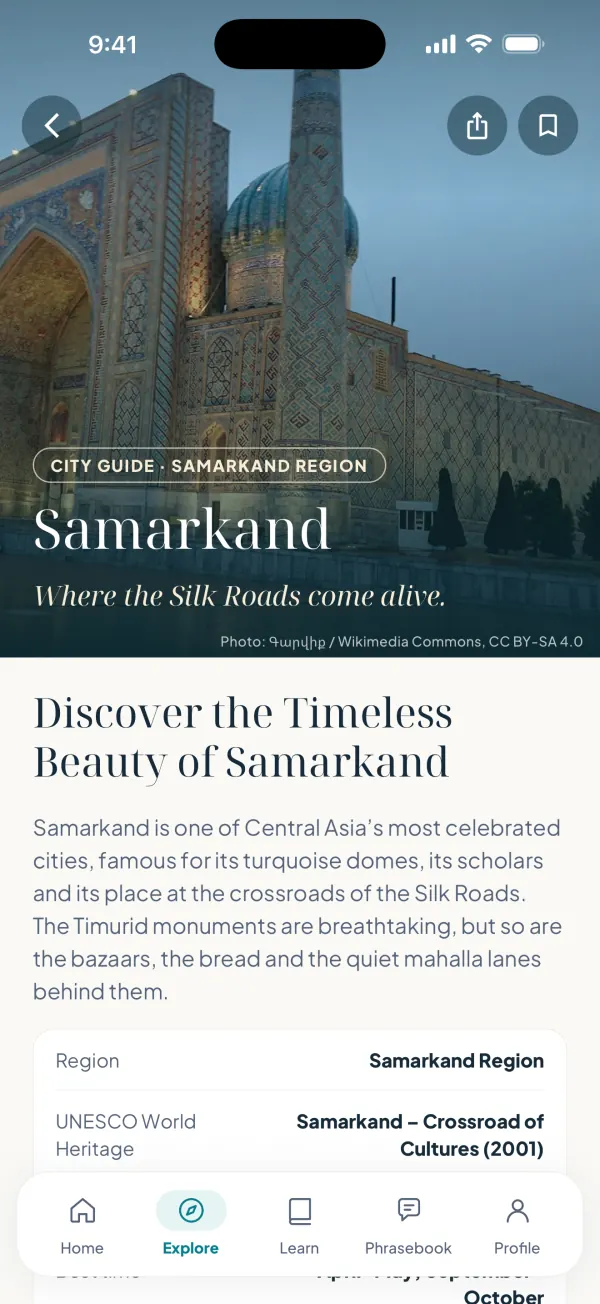
Photo: Գարվիք / Wikimedia Commons, CC BY-SA 4.0

Photo: Adam Jones from Kelowna, BC, Canada / Wikimedia Commons, CC BY-SA 2.0

Photo: Adam Harangozó / Wikimedia Commons, CC BY-SA 4.0

Photo: Bgag / Wikimedia Commons

Photo: Jean-Pierre Dalbéra from Paris, France / Wikimedia Commons, CC BY 2.0
Get the app
Save places to your trip plans, learn the Uzbek you’ll need with clear audio, and keep city guides and phrases in your pocket.

Android Google Play · coming soon
Scan with your iPhone camera to open the App Store.