
Landmark
Savitsky Museum
Republic of Karakalpakstan
The banned Soviet avant-garde, saved in a desert city.

Uzbekistan · Desert and sea
Desert fortresses, forbidden art and the story of the Aral Sea.
Karakalpakstan is a vast autonomous republic covering more than a third of Uzbekistan.
Discover Karakalpakstan
Karakalpakstan is a vast autonomous republic covering more than a third of Uzbekistan. Its wide open spaces are unforgettable: a world-class art museum in Nukus, ancient mud-brick fortresses rising from the desert, and the ship cemetery at Muynak, where the shore of the Aral Sea once lay.

Only stable facts are shown. Prices, opening hours and entry rules change, so check official sources before you travel.
Must-see attractions
Landmark
Republic of Karakalpakstan
The banned Soviet avant-garde, saved in a desert city.
Landmark
Republic of Karakalpakstan
Fishing boats resting on the old seabed, where the Aral Sea once reached.
Historic site
Republic of Karakalpakstan
Mud-brick desert fortresses watching over ancient Khorezm.
Nature
Republic of Karakalpakstan
A sea of shifting shores, reached across the Ustyurt Plateau.
History of Karakalpakstan
The lands of ancient Khorezm spread across the Amu Darya delta here, and dozens of mud-brick fortresses such as Ayaz Kala and Toprak Kala still stand in the desert. The Karakalpaks, a Turkic people with their own language, have lived in the delta for centuries.
From the 1960s, the rivers feeding the Aral Sea were diverted to irrigate farmland, and the sea shrank to a fraction of its size. Muynak, once a busy fishing port, now keeps that story alive in its museum and ship cemetery.
Culture & local life
Tens of thousands of works, including avant-garde art banned in Soviet times, saved by Igor Savitsky.
Embroidered costumes and jewellery, with the saukele bridal headdress as the showpiece.
Bards accompany long heroic poems on the qobyz, a bowed folk instrument.
Food & gastronomy
Karakalpak food is built for cold desert winters: boiled meat with handmade noodles, rich broths and bread. Fish once came straight from the Aral; today it comes mostly from the delta’s lakes.

A clear, hearty lamb broth with big-cut vegetables.

The national dish: rice slow-cooked with lamb, carrots and cumin.

Round tandoor bread, stamped and baked to a golden crust.
Dish origins are often shared across Central Asia; Salom describes how dishes are made and eaten here, not where they were invented.
Map
Filter by type, select a place to preview it, or open directions.
Schematic map · no streets drawn · positions approximate, for orientation only. Use Directions to navigate.
Landmark
Muynak Ship CemeteryFishing boats resting on the old seabed, where the Aral Sea once reached.
Practical travel guide
General guidance. Time-sensitive details link to official sources.
Fly from Tashkent to Nukus, or travel overland from Khiva and Urgench, about three hours by car.
Uzbekistan AirwaysApril to May and September to October. Summers are very hot and winters cold.
Muynak is about 200 km from Nukus. Hire a driver for the day and bring water and snacks.
Learn useful Uzbek
Stressed syllables are in capitals.
Salom
Sah-LOHM
Hello (informal)
Rahmat
Rah-MAHT
Thank you
Kechirasiz
Keh-chee-RAH-seez
Excuse me / Sorry
Bu qancha?
Boo kahn-chah?
How much is this?
Stories

Destinations
A traveler's guide to Karakalpakstan: the Moynaq ship graveyard, the shrinking Aral Sea, the Savitsky museum in Nukus, and yurt-camp logistics.
Keep exploring

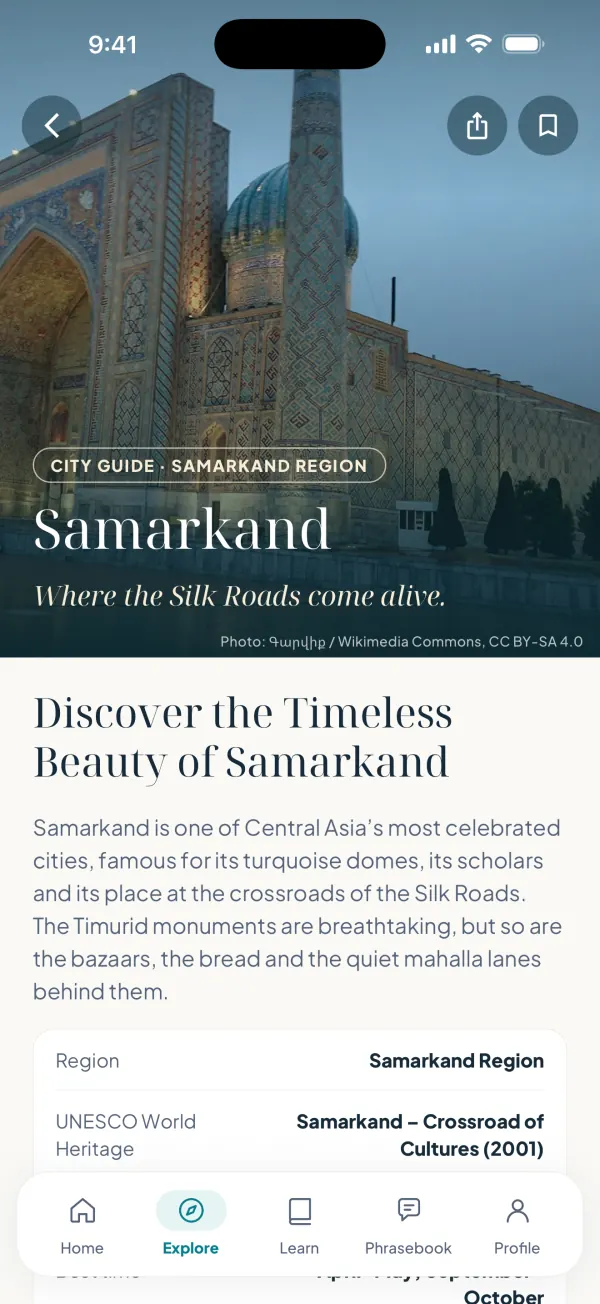
Photo: Գարվիք / Wikimedia Commons, CC BY-SA 4.0

Photo: Adam Jones from Kelowna, BC, Canada / Wikimedia Commons, CC BY-SA 2.0

Photo: Adam Harangozó / Wikimedia Commons, CC BY-SA 4.0

Photo: Bgag / Wikimedia Commons

Photo: Bobyrr / Wikimedia Commons, CC BY-SA 4.0
Get the app
Save places to your trip plans, learn the Uzbek you’ll need with clear audio, and keep city guides and phrases in your pocket.

Android Google Play · coming soon
Scan with your iPhone camera to open the App Store.