Karakalpakstan: The Aral Sea, Moynaq & Nukus
A traveler's guide to Karakalpakstan: the Moynaq ship graveyard, the shrinking Aral Sea, the Savitsky museum in Nukus, and yurt-camp logistics.
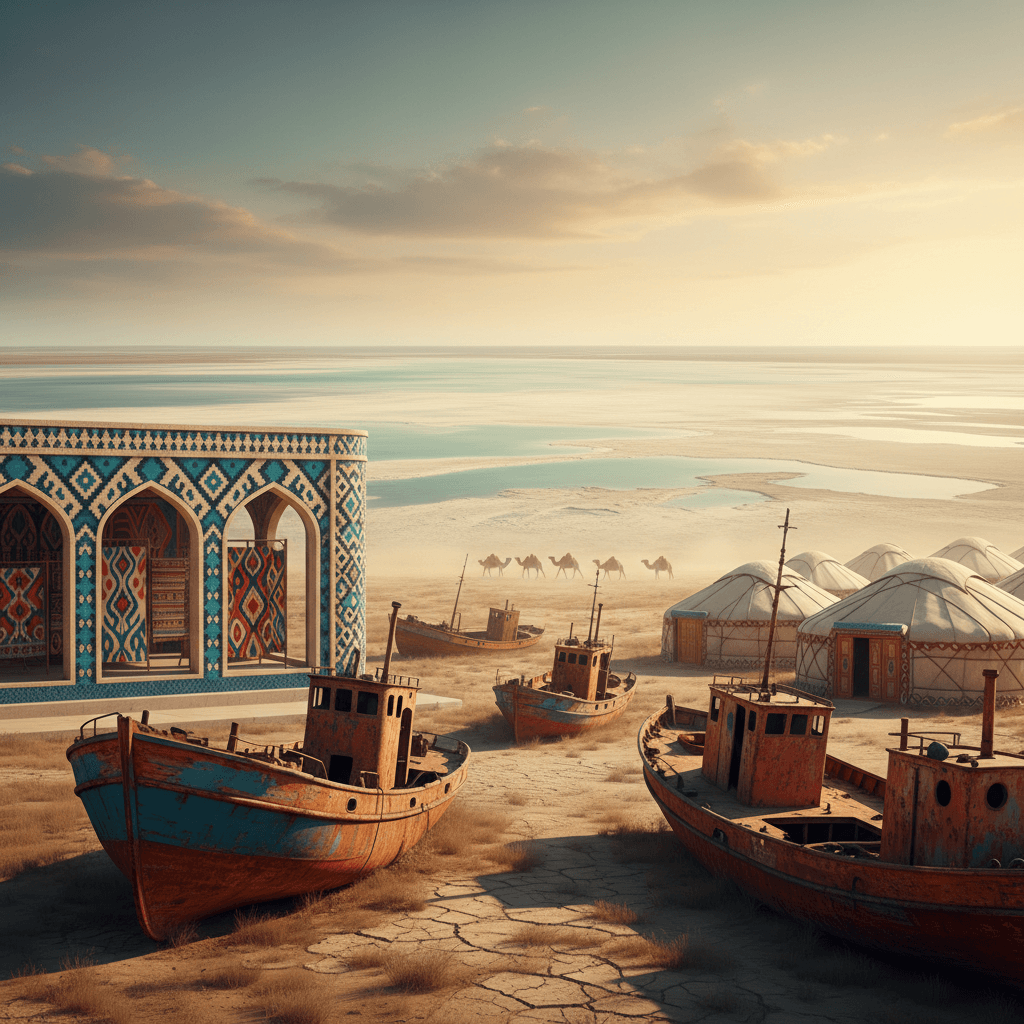
Most people fly into Uzbekistan for Samarkand, Bukhara and Khiva, then fly out. If you have a few extra days and a taste for the strange, keep going west.
Karakalpakstan is the autonomous republic that covers the whole northwest of the country. It’s flat, dry, thinly peopled, and home to two of the most affecting sights in Central Asia: a fleet of rusting ships stranded in the desert, and a museum full of banned Soviet art nobody expected to survive.
Why go to Karakalpakstan at all
This is the part of Uzbekistan that feels least like a postcard. The Karakalpak people have their own Turkic language (closer to Kazakh than to Uzbek), their own food, and a landscape shaped by one of the worst environmental disasters of the last century.
You come here for three things, honestly: the Moynaq ship graveyard, the Savitsky museum in Nukus, and a night in a yurt near what’s left of the Aral Sea. Everything else is desert, salt, and long straight roads.
A useful greeting: Karakalpak and Uzbek both use Assalomu alaykum ah-sah-LOM-u ah-LAY-koom (peace be upon you). It works everywhere.
The Aral Sea in Uzbekistan: what actually happened
The Aral Sea was once one of the largest lakes on earth. Soviet planners diverted the two rivers that fed it, the Amu Darya and Syr Darya, to irrigate cotton fields. The sea began shrinking in the 1960s and never stopped.
What remains has split into smaller, saltier pools. The southern part, the one Uzbekistan borders, has largely dried out. Where fishing boats once worked, there’s now the Aralkum, a salt desert that didn’t exist a lifetime ago.
The town of Moynaq sat on the shore. Today the water is roughly 150 to 200 km away, depending on where you measure. Locals will tell you their grandparents remember the waves. That’s the story you actually feel when you stand there.
The Moynaq ship graveyard
Moynaq is the reason the Aral Sea disaster went viral before “viral” meant anything. A cluster of fishing vessels sits marooned on cracked seabed, tilted at odd angles, orange with rust.
They’ve been arranged near a bluff below the town, with a memorial and a small museum nearby. You can walk right up to the hulls, climb a couple of them, and look out over the flat nothing that used to be sea.
Go at sunrise or the hour before sunset. The light is kinder and the heat is survivable. In summer this place bakes, and there’s almost no shade.
Moynaq is about a 3 to 4 hour drive north of Nukus on decent asphalt. Most travelers hire a car and driver in Nukus for a day trip, or fold it into a longer yurt-camp tour. If you’re navigating on your own, our directions phrases cover the basics for asking the way when signage runs out.
The Nukus Savitsky museum
Here’s the surprise. In a plain building in a dusty provincial capital sits one of the great collections of Soviet avant-garde art anywhere.
Igor Savitsky was an artist and collector who, from the 1950s, gathered thousands of works that Moscow considered degenerate or dangerous. He brought them to Nukus, far from the censors, and stored them where nobody was looking. Paintings that would have been destroyed elsewhere quietly outlived the regime that banned them.
The Savitsky museum (officially the Karakalpakstan State Museum of Art) now holds tens of thousands of pieces: avant-garde canvases, Karakalpak folk textiles, jewelry, and archaeological finds. Only a fraction is on display at any time, and photography rules change, so ask at the desk.
Give it two to three hours. It’s the single best reason to stop in Nukus, and it reframes the whole trip. Say Rahmat rah-MAHT (thank you) to the guardians who sit in each room; they’ve watched over this art for decades.
Sleeping in a yurt near the Aral Sea
Several operators run yurt camps out on the former seabed or near the surviving water, usually reached from Moynaq by 4x4 across the salt flats. It’s a long, bumpy ride, and that’s part of the point.
What to expect at a camp:
- Simple yurts with mattresses on the floor, shared and basic bathrooms
- Meals cooked on site, often fish (when available), bread, and tea
- Cold desert nights even after hot days, so pack layers year-round
- Little to no phone signal, so download maps and phrases before you leave Nukus
- A canyon detour to the Ustyurt Plateau on some longer tours
Book through a Nukus-based agency and confirm exactly what’s included, since these trips are logistics-heavy and prices swing with fuel and group size. Tea will appear the moment you arrive; that’s the Uzbek hospitality you’ll have met everywhere on your trip. A warm Rahmat rah-MAHT goes a long way with your hosts.
If a remote overnight by water appeals but you’d rather stay closer to the classic route, Aydarkul Lake offers a gentler yurt-camp experience between Samarkand and the desert.
Getting to Nukus
Nukus is the gateway, and it’s genuinely far from everything.
- By air: the quickest option. Domestic flights connect Tashkent to Nukus in about 2 hours. Fly at least one leg if your time is tight.
- By train: overnight services run from Tashkent and stop at Nukus. It’s slow but cheap, and you’ll wake up somewhere completely different.
- By road from Khiva: Nukus is roughly 3 hours from Khiva, which makes a Khiva-then-Nukus routing sensible. See our Khiva guide to plan the pairing.
A few words of Karakalpak or Uzbek help in taxis and shops. Qancha? kahn-CHAH means how much, and Yo'q yoke means no, both handy when a fare needs negotiating.
When to go
Spring (April to May) and autumn (September to October) are the comfortable windows. Summer out here is punishing, with daytime heat on the salt flats that saps you fast. Winter is cold and stark but photogenic, if you’re prepared for it. For the wider picture, our month-by-month guide breaks down the seasons.
Frequently asked questions
Is Karakalpakstan worth visiting?
Yes, if you have three or more spare days and want something beyond the Silk Road cities. The Savitsky museum and the Moynaq ships are unlike anything else in Uzbekistan. Skip it only if your trip is short.
How do you get to the Moynaq ship graveyard?
Moynaq is about a 3 to 4 hour drive north of Nukus by paved road. Most travelers hire a car and driver in Nukus, either for a day trip or as part of a multi-day yurt-camp tour.
Can you still see the Aral Sea in Uzbekistan?
You can, but only the shrunken remnant, and it’s far from the old shore. Reaching actual water from Moynaq means a long 4x4 ride across the dried seabed, usually with a yurt-camp operator.
What language do people speak in Karakalpakstan?
Karakalpak, a Turkic language close to Kazakh, alongside Uzbek and Russian. Uzbek greetings and phrases are widely understood, so you won’t be stuck.
Is Nukus safe for travelers?
Generally yes, with the same everyday caution you’d use anywhere. For a fuller picture across the country, read our honest safety guide.
Out past Nukus the signal drops and the phrasebooks in your bag stop being decorative. Salom Uzbekistan keeps Uzbek phrases and audio on your phone for exactly those moments, available offline so a dead signal never means a lost conversation.