
Uzbek Hospitality
Welcoming traditions and social customs.

Culture & Traditions
Where hospitality, creativity and tradition come together.
Explore the customs, flavours, crafts, music and everyday stories that make Uzbekistan’s culture so welcoming.
The people & their stories
Uzbekistan’s cultural life reflects centuries of exchange, creativity and community. From shared meals and handmade crafts to music and celebrations, its traditions keep evolving from one generation to the next.
Uzbekistan is home to Uzbeks, Karakalpaks, Tajiks, Kazakhs, Russians, Koreans and many other communities, and life in Tashkent differs from life in a Khorezm village. What follows describes widely shared traditions, not rules every family follows.
How we write about culture: traditions are described as practices, not universal rules; regional differences are named; and facts link to their sources.

Explore by theme
Welcoming traditions and social customs.
The stories behind traditional dishes.
Ceramics, silk, embroidery and woodcarving.
Classical maqom, instruments and dance.
Navruz and the festivals of the year.
Ikat, embroidery and regional styles.
Everyday situations, handled with grace.
Cook, paint, weave and listen.
Showing 9 of 76 topics
Customs & Etiquette
Understanding the 'Mehmondorchilik' tradition and the guest's sacred role.
Food & Gastronomy
The national dish: rice slow-cooked with lamb, carrots and cumin.
Arts & Crafts
Rishton Ceramics
Cobalt and turquoise glazes from the Fergana Valley’s pottery town.
Music & Dance
Shashmaqom
Six maqoms of song, poetry and instruments, the classical music of Bukhara.
Holidays & Celebrations
Navruz
Navruz, “new day”, welcomes spring at the equinox. 21 March is a public holiday, but the festivities fill the weeks around it. Families cook sumalak, visit relatives and exchange gifts, and parks and mahallas fill with music, games and food.
Traditional Clothing
Atlas and adras
Ikat silks with soft, cloud-edged patterns, the pride of Margilan.
Cultural Experiences
Plov Cooking Class
Cook Uzbekistan’s national dish in a kazan, then share it at the table.
Customs & Etiquette
Proper handshakes, the 'hand-to-heart' gesture, and formal addresses.
Food & Gastronomy
Hand-pulled noodles in a spiced meat-and-vegetable broth.
Arts & Crafts
Gijduvan Ceramics
Warm browns, ochres and greens from the potters of Gijduvan, near Bukhara.
Music & Dance
Katta Ashula
The “big song” of the Fergana Valley, sung by two to five voices.
Holidays & Celebrations
Independence Day
Independence Day on 1 September is Uzbekistan’s main national holiday. It marks the independence declared on 31 August 1991, and towns and cities celebrate with concerts, fairs and fireworks.
Traditional Clothing
Chapan
The long quilted robe, worn with pride and given in honour.
Cultural Experiences
Dinner with a Local Family
Sit at a family’s dastarkhan and learn hospitality from the inside.
Customs & Etiquette
The ritual of tea pouring and why a half-full cup is a sign of respect.
Food & Gastronomy
A clear, hearty lamb broth with big-cut vegetables.
Arts & Crafts
Ikat Silk
Cloud-like patterns dyed into the thread before a single row is woven.
Music & Dance
Bakhshi epic singers
Centuries-old epics, sung from memory to the dombra.
Holidays & Celebrations
Constitution Day
Constitution Day on 8 December marks the adoption of the Constitution of the Republic of Uzbekistan, the country’s fundamental law, on 8 December 1992. It is an official day off.
Traditional Clothing
Doppi skullcap
The four-sided cap whose pattern hints at where it was made.
Cultural Experiences
Margilan Silk Workshop
Follow silk from cocoon to ikat at the Yodgorlik factory.
Customs & Etiquette
Etiquette for entering a home, removing shoes, and bringing gifts.
Food & Gastronomy
Thin noodles tossed with horse meat, a nomadic classic.
Arts & Crafts
Silk Carpets
Hand-knotted carpets that bring old Timurid designs back to life.
Music & Dance
Askiya, the art of wit
A duel of quick, improvised wit, played for laughs.
Holidays & Celebrations
Teachers’ and Mentors’ Day
On 1 October pupils, students and trainees thank the teachers and mentors who taught them. Teachers are highly respected in Uzbekistan, and the day is an official day off.
Traditional Clothing
Ko‘ylak and lozim
A loose, tunic-cut dress over trousers, in the brightest silk.
Cultural Experiences
Rishton Pottery Workshop
Paint a plate in turquoise and cobalt in Uzbekistan’s pottery town.
Customs & Etiquette
Dress codes and behavior when visiting active religious sites.
Food & Gastronomy
Big steamed dumplings filled with spiced meat and onion.
Arts & Crafts
Suzani
Dowry embroideries of suns, moons and pomegranates, stitched by hand.
Music & Dance
Lazgi
Khorezm’s joyful dance of nature, love and happiness.
Holidays & Celebrations
Day of Remembrance and Honour
On 9 May Uzbekistan remembers the people who fought and died in the Second World War and pays its respects to the older generation. Families lay flowers at memorials and visit veterans with gifts.
Traditional Clothing
Gold-embroidered robes
Bukhara’s gold-thread robes, made for court and celebration.
Cultural Experiences
Silk Paper Making at Konigil
Make paper from mulberry bark at a mill driven by a water wheel.
Customs & Etiquette
The hierarchy of elders and the central role of family in daily life.
Food & Gastronomy
Flaky baked pastries stuffed with meat or pumpkin.
Arts & Crafts
Bukhara Gold Embroidery
Gold thread on velvet, once made for the emir’s court.
Music & Dance
Boysun folklore
A mountain district where very old songs, rites and dances live on.
Holidays & Celebrations
International Women’s Day
On 8 March families and friends congratulate the women in their lives with flowers, gifts and a festive table. It is an official day off.
Traditional Clothing
Khorezm sheepskin hat
Khorezm’s tall, shaggy sheepskin hat, worn all year round.
Cultural Experiences
Samarkand by Night
See the Registan glow under lights after the day crowds leave.
Customs & Etiquette
The art of respectful bargaining and navigating traditional markets.
Food & Gastronomy
Tiny dumplings served in broth or fried crisp.
Arts & Crafts
Do‘ppi Skullcaps
The four-cornered cap that tells you where its wearer comes from.
Music & Dance
Dutar
The long-necked, two-stringed lute at the heart of Uzbek song.
Holidays & Celebrations
New Year
New Year is one of the best-loved holidays in Uzbekistan. Streets and homes sparkle with lights and decorated trees, families gather around a full table, and everyone makes a wish as the clock strikes twelve.
Traditional Clothing
Belbog‘ sash
The waist scarf tied over a robe.
Cultural Experiences
Tashkent Metro Station Tour
Ride Central Asia’s first metro past chandeliers, mosaics and cosmonauts.
Customs & Etiquette
Understanding the grand celebrations and traditional ceremonies.
Food & Gastronomy
Char-grilled skewers of marinated meat over open coals.
Arts & Crafts
Khiva Woodcarving
Carved doors and columns, and the folding book stand cut from one board.
Music & Dance
Doira
The jingling frame drum that keeps time for song and dance.
Holidays & Celebrations
Ramazon hayit (Eid al-Fitr)
Ramazon hayit, Eid al-Fitr, marks the end of the month of fasting. Families visit relatives and elders, help people in need and set out tables of plov, sweets, samsa and bread. The first day is an official holiday.
Traditional Clothing
Traditional jewellery
Silver, coral and turquoise, made in sets to be worn together.
Cultural Experiences
Bukhara Folklore & Fashion Show
Music, dance and silk costumes in a 17th-century madrasa courtyard.
Food & Gastronomy
A slow-steamed one-pot of meat and layered vegetables.
Arts & Crafts
Chust Knives
The Uzbek pichoq, forged in Chust and found in every kitchen.
Music & Dance
Rubab
A carved and inlaid lute, shared by four countries.
Holidays & Celebrations
Qurbon hayit (Eid al-Adha)
Qurbon hayit, Eid al-Adha, is the second of the two great festivals of Islam. Families share festive meals with their neighbours, visit relatives and remember loved ones. The first day is an official holiday.
Traditional Clothing
Wedding attire
Ikat, gold thread and silver for the biggest day.
Cultural Experiences
Traditional Hammam in Bukhara
Steam, scrub and massage under the domes of a centuries-old bathhouse.
Food & Gastronomy
Round tandoor bread, stamped and baked to a golden crust.
Arts & Crafts
Bukhara Copper Chasing
Trays and jugs patterned by hammer and chisel, tap by tap.
Music & Dance
Karnay and surnay
Long brass trumpets and a bright reed pipe that announce a celebration.
Holidays & Celebrations
Weddings
A wedding, nikoh to‘yi, is a major family occasion in Uzbek life. Relatives near and far, friends, colleagues and neighbours are invited, so a wedding can bring together hundreds of guests.
Cultural Experiences
Yurt Camp & Camel Ride at Aydarkul
Sleep in a felt yurt under desert stars and ride a camel to the dunes.
Food & Gastronomy
A dense, sweet confection of nuts, sugar and flour.
Arts & Crafts
Samarkand Paper
Glossy mulberry-bark paper, made by hand beside a water mill.
Music & Dance
Miniature painting
Tiny, jewel-bright paintings in the tradition of the great book painters.
Holidays & Celebrations
Cradle celebration
Beshik to‘y celebrates a baby being placed in the beshik, the traditional cradle, for the first time. Relatives gather with gifts, food and music to welcome the newest member of the family.
Cultural Experiences
Nuratau Village Homestay
Stay with a mountain family, walk to petroglyphs and eat from the garden.
Food & Gastronomy
The drink that accompanies every meal and every welcome.
Arts & Crafts
Miniature Painting
Tiny, jewel-bright scenes of poets, gardens and caravans.
Holidays & Celebrations
Harvest festivals
As summer turns to autumn, Uzbekistan celebrates its harvest. Melon, grape and pomegranate festivals show off the best fruit of each region, with folk music, dancing and festive meals.
Cultural Experiences
Chimgan & Beldersay Hike
Ride a chairlift, hike alpine meadows and cool off at Charvak.
No topics match that search. Try another word.
Uzbek hospitality
The traditions and values that shape how guests are welcomed in Uzbekistan.
Understanding the 'Mehmondorchilik' tradition and the guest's sacred role.
Proper handshakes, the 'hand-to-heart' gesture, and formal addresses.
The ritual of tea pouring and why a half-full cup is a sign of respect.
Etiquette for entering a home, removing shoes, and bringing gifts.
The hierarchy of elders and the central role of family in daily life.

Food & gastronomy
Many of these dishes are shared across Central Asia and beyond; what is special is how they are cooked and shared here.

The national dish: rice slow-cooked with lamb, carrots and cumin.

Flaky baked pastries stuffed with meat or pumpkin.

Big steamed dumplings filled with spiced meat and onion.

Hand-pulled noodles in a spiced meat-and-vegetable broth.

Round tandoor bread, stamped and baked to a golden crust.

The drink that accompanies every meal and every welcome.
Arts & crafts
From Rishton’s blue glazes to Bukhara’s gold thread, each region has crafts of its own.

Fergana
Cobalt and turquoise glazes from the Fergana Valley’s pottery town.

Bukhara
Warm browns, ochres and greens from the potters of Gijduvan, near Bukhara.

Fergana
Cloud-like patterns dyed into the thread before a single row is woven.

Khorezm
Hand-knotted carpets that bring old Timurid designs back to life.

Bukhara
Dowry embroideries of suns, moons and pomegranates, stitched by hand.

Bukhara
Gold thread on velvet, once made for the emir’s court.

Namangan
The four-cornered cap that tells you where its wearer comes from.

Khorezm
Carved doors and columns, and the folding book stand cut from one board.

Namangan
The Uzbek pichoq, forged in Chust and found in every kitchen.

Bukhara
Trays and jugs patterned by hammer and chisel, tap by tap.

Samarkand
Glossy mulberry-bark paper, made by hand beside a water mill.

Bukhara
Tiny, jewel-bright scenes of poets, gardens and caravans.
Music & performing arts
Classical suites, long-necked lutes, frame drums and regional dance.
music
Six maqoms of song, poetry and instruments, the classical music of Bukhara.
UNESCO Intangible Heritage · 2008
Source: UNESCO Intangible Cultural Heritage: Shashmaqom music
music
The “big song” of the Fergana Valley, sung by two to five voices.
UNESCO Intangible Heritage · 2009

music
Centuries-old epics, sung from memory to the dombra.
UNESCO Intangible Heritage · 2021
Source: UNESCO Intangible Cultural Heritage: Bakhshi art
Photo: Bekipediya / Wikimedia Commons, CC BY-SA 4.0
theatre
A duel of quick, improvised wit, played for laughs.
UNESCO Intangible Heritage · 2014
Source: UNESCO Intangible Cultural Heritage: Askiya, the art of wit

dance
Khorezm’s joyful dance of nature, love and happiness.
UNESCO Intangible Heritage · 2019
Source: UNESCO Intangible Cultural Heritage: Khorazm dance, Lazgi
Photo: AIDEPCUL / Wikimedia Commons, CC BY 4.0
Holidays & celebrations
These are traditions, not a list of upcoming events. Fixed dates recur every year; others move and are confirmed each year.

seasonal
Fixed: 21 March (public holiday)
Navruz, “new day”, welcomes spring at the equinox. 21 March is a public holiday, but the festivities fill the weeks around it. Families cook sumalak, visit relatives and exchange gifts, and parks and mahallas fill with music, games and food.
Source: Uzbekistan National Tourism Information Center (uzbekistan.travel): Navruz and the spring equinox

national
Fixed: 1 September (public holiday)
Independence Day on 1 September is Uzbekistan’s main national holiday. It marks the independence declared on 31 August 1991, and towns and cities celebrate with concerts, fairs and fireworks.
Source: Uzbekistan National Tourism Information Center (uzbekistan.travel): Independence Day: September 1
national
Fixed: 8 December (public holiday)
Constitution Day on 8 December marks the adoption of the Constitution of the Republic of Uzbekistan, the country’s fundamental law, on 8 December 1992. It is an official day off.
Source: Uzbekistan National Tourism Information Center (uzbekistan.travel): December 8: Constitution Day
national
Fixed: 1 October (public holiday)
On 1 October pupils, students and trainees thank the teachers and mentors who taught them. Teachers are highly respected in Uzbekistan, and the day is an official day off.

national
Fixed: 9 May (public holiday)
On 9 May Uzbekistan remembers the people who fought and died in the Second World War and pays its respects to the older generation. Families lay flowers at memorials and visit veterans with gifts.
national
Fixed: 8 March (public holiday)
On 8 March families and friends congratulate the women in their lives with flowers, gifts and a festive table. It is an official day off.

national
Fixed: 1 January (public holiday)
New Year is one of the best-loved holidays in Uzbekistan. Streets and homes sparkle with lights and decorated trees, families gather around a full table, and everyone makes a wish as the clock strikes twelve.
Source: Uzbekistan National Tourism Information Center (uzbekistan.travel): January 1: New Year
religious
Moves each year: follows the lunar calendar (public holiday)
Ramazon hayit, Eid al-Fitr, marks the end of the month of fasting. Families visit relatives and elders, help people in need and set out tables of plov, sweets, samsa and bread. The first day is an official holiday.
Source: Uzbekistan National Tourism Information Center (uzbekistan.travel): Ramadan Khait
religious
Moves each year: follows the lunar calendar (public holiday)
Qurbon hayit, Eid al-Adha, is the second of the two great festivals of Islam. Families share festive meals with their neighbours, visit relatives and remember loved ones. The first day is an official holiday.
family
Throughout the year
A wedding, nikoh to‘yi, is a major family occasion in Uzbek life. Relatives near and far, friends, colleagues and neighbours are invited, so a wedding can bring together hundreds of guests.
Source: The Ohio State University, Uzbek language resources: Weddings

family
Throughout the year
Beshik to‘y celebrates a baby being placed in the beshik, the traditional cradle, for the first time. Relatives gather with gifts, food and music to welcome the newest member of the family.

seasonal
Usually August or September or October; check official announcements
As summer turns to autumn, Uzbekistan celebrates its harvest. Melon, grape and pomegranate festivals show off the best fruit of each region, with folk music, dancing and festive meals.
Source: Uzbekistan National Tourism Information Center (uzbekistan.travel): Harvest celebration
Traditional clothing & textiles

Ikat silks with soft, cloud-edged patterns, the pride of Margilan.
Photo: Panpanchik / Wikimedia Commons, CC BY-SA 4.0

The long quilted robe, worn with pride and given in honour.
Photo: Hiart / Wikimedia Commons

The four-sided cap whose pattern hints at where it was made.
Photo: MarjonaKhidirova / Wikimedia Commons, CC BY-SA 4.0
A loose, tunic-cut dress over trousers, in the brightest silk.

Bukhara’s gold-thread robes, made for court and celebration.
Photo: Davide Mauro / Wikimedia Commons, CC BY-SA 4.0

Khorezm’s tall, shaggy sheepskin hat, worn all year round.
Photo: AIDEPCUL / Wikimedia Commons
Customs & etiquette
6 everyday situations. Customs vary between families, regions and generations; when in doubt, follow your hosts.
Customs vary between regions, families, generations and individuals. These are common practices, not rules. Follow local guidance and respect personal preferences. Visitors who are trying are almost always forgiven a slip.
Sources: UK government travel advice (GOV.UK)Official tourism portal of Uzbekistan
Scenario
You’re introduced to a woman at a family dinner. How do you greet her?
What would you do?
Interactive discovery
Short questions with sourced answers. No registration, and nothing is saved.
Question 1 of 6
Score 0
You’re invited for a meal. What is the dastarkhan?
Cultural experiences
Hands-on ways to meet Uzbek culture. Salom doesn’t sell bookings; ask your guesthouse or a local tour office.

Cook Uzbekistan’s national dish in a kazan, then share it at the table.
Photo: Ekrem Canli / Wikimedia Commons, CC BY-SA 3.0

Paint a plate in turquoise and cobalt in Uzbekistan’s pottery town.
Photo: Asturio Cantabrio / Wikimedia Commons, CC BY-SA 4.0

Follow silk from cocoon to ikat at the Yodgorlik factory.
Photo: upyernoz from Haverford, USA / Wikimedia Commons, CC BY 2.0

Music, dance and silk costumes in a 17th-century madrasa courtyard.
Photo: Alaexis / Wikimedia Commons, CC BY-SA 2.5

Sit at a family’s dastarkhan and learn hospitality from the inside.
Photo: Damirovna / Wikimedia Commons, CC BY 4.0
Stories

Culture & Traditions
Religion in Uzbekistan is mostly secular Sunni Islam with Sufi roots. Here's what it means for mosque etiquette, dress, Ramadan, and the great monuments.

Culture & Traditions
Uzbek tea is the heart of every social moment. Learn the choyxona, the three-pour ritual, green vs black, the piyola, and how to accept a cup politely.

Food & Gastronomy
A short culture guide to uzbek bread: the tandoor, the chekich stamps, heavy Samarkand loaves, and the taboos every traveler should know.
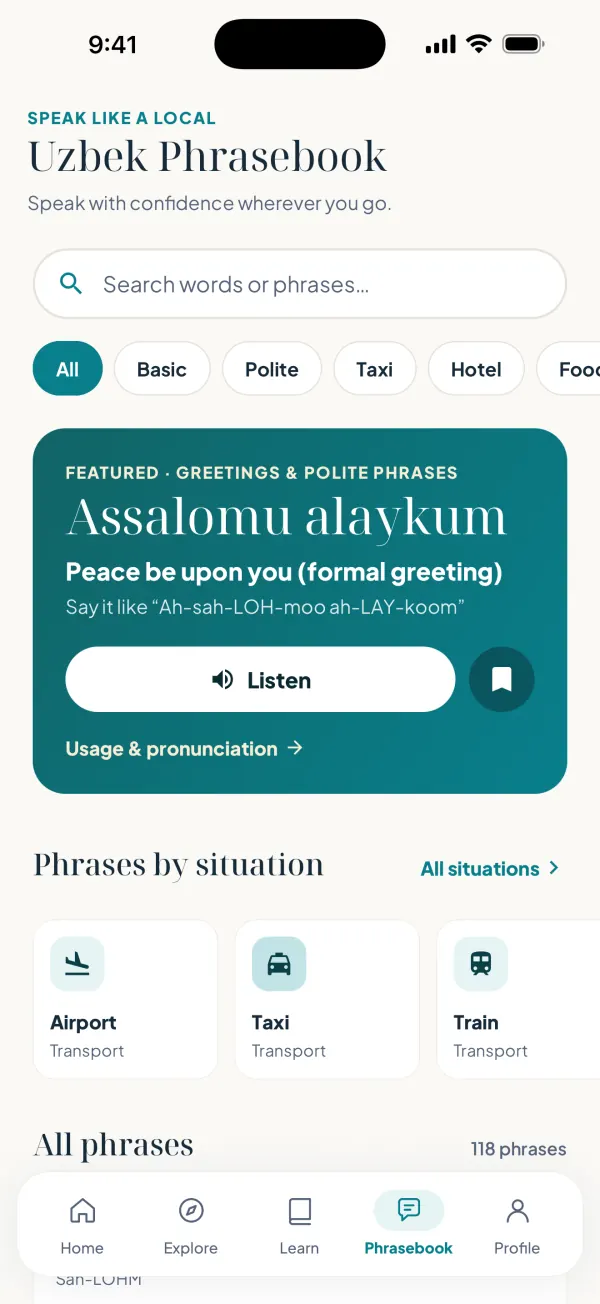
Useful Uzbek
Words that open doors at the table, the bazaar and a celebration.
Assalomu alaykum
ahs-sah-LOH-moo ah-LAY-koom
Peace be upon you
Juda mazali!
joo-DAH mah-zah-LEE
Very delicious!
Mehmondorchilik uchun rahmat
meh-mon-dor-chee-LEEK oo-CHOON rah-MAHT
Thank you for the hospitality
Tabriklaymiz!
tahb-reek-LAY-meez
Congratulations!
Get the app
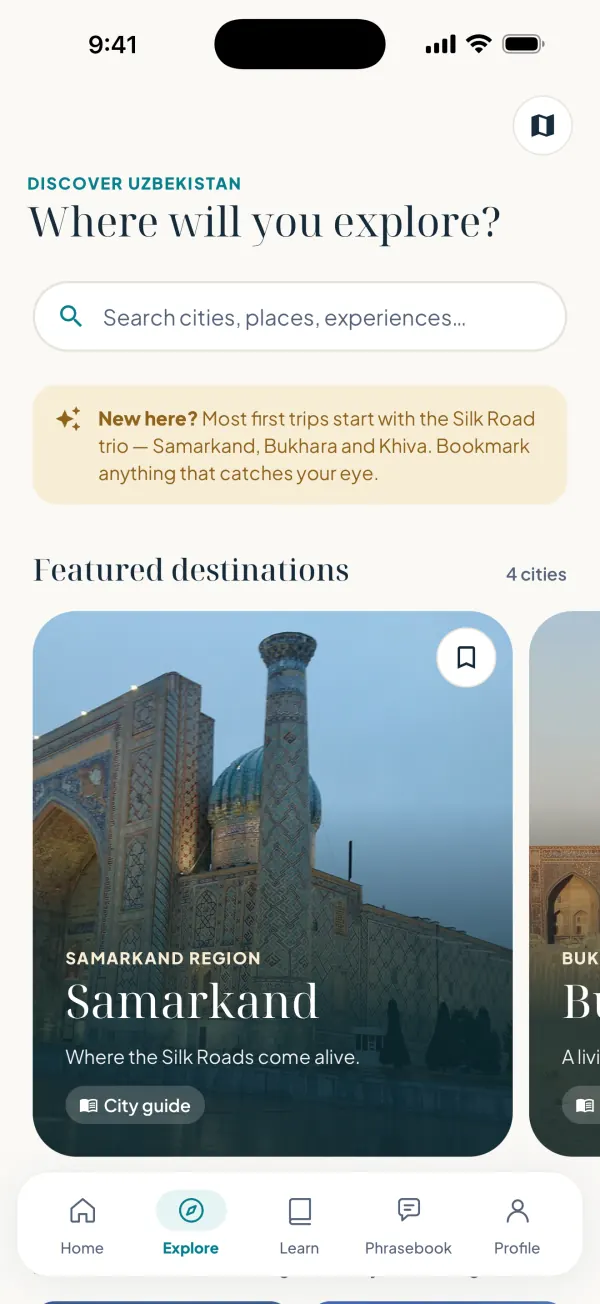
Read etiquette guides, learn useful expressions and explore crafts, celebrations and food wherever you go. Free to download, with a free trial of everything.

Android Google Play · coming soon
Scan with your iPhone camera to open the App Store.