Uzbek Bread (Non): The Loaf You Don't Cut
A short culture guide to uzbek bread: the tandoor, the chekich stamps, heavy Samarkand loaves, and the taboos every traveler should know.
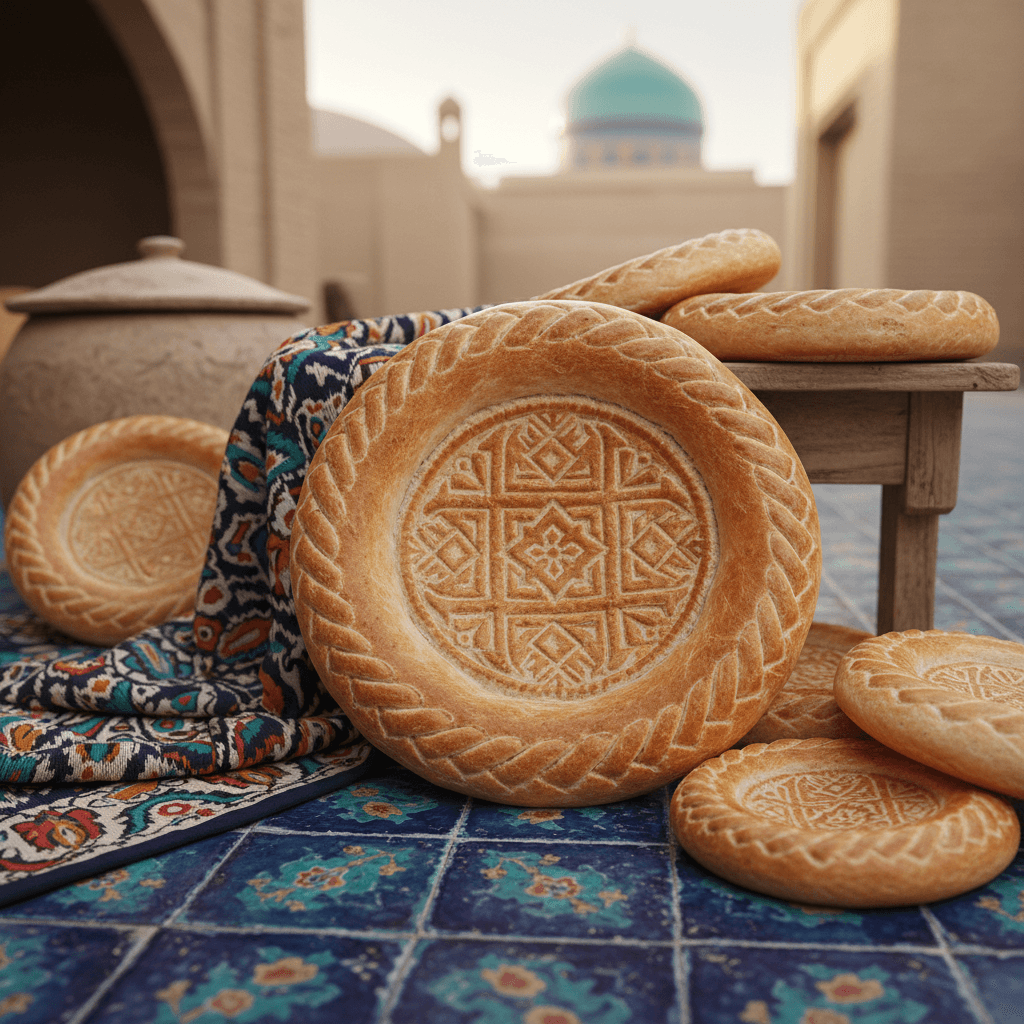
You’ll meet Uzbek bread before you sit down to any meal. It arrives torn into pieces at the center of the table, round and golden, sometimes still warm from the clay oven. This is non nohn , and in Uzbekistan it’s closer to a household member than a side dish.
Understanding it will change how you eat here, and it’ll keep you from a couple of small mistakes that locals notice instantly.
What is non bread, exactly?
Uzbek bread is a round, leavened flatbread baked against the wall of a clay oven called a tandir tahn-DEER . The everyday version is obi non OH-bee nohn , a plain loaf with a puffed rim and a flat, stamped center. “Obi” points to water in the dough, which keeps the crumb soft under a crisp shell.
The center stays thin and dense while the edges rise into a chewy ring. You tear from the rim, not slice. Bread here is broken by hand, always, and passed around rather than cut with a knife.
Every region bakes its own style. Tashkent loaves tend to be lighter and higher-rimmed. Samarkand bakes something almost architectural, which we’ll get to.
The tandoor and the chekich stamp
The tandir tahn-DEER does the real work. It’s a deep clay oven, often shaped like a barrel, fired with wood or coal until the walls glow. The baker slaps a wet disc of dough directly onto the hot inner wall, where it sticks, bakes, and is peeled off minutes later with a hook.
That’s why one side of the loaf is smooth and blistered and the other is domed. It baked against the wall.
The pattern in the middle isn’t decoration for its own sake. Bakers press the dough with a chekich cheh-KEECH , a small wooden stamp studded with pins or nails. The pricked center stops that part from puffing up, so the rim rises and the middle stays flat.
Those starbursts and floral rings often mark a particular baker or family. Walk through Chorsu Bazaar in Tashkent and you’ll see stacks of loaves, each stamped a little differently, sometimes sprinkled with sesame or kalonji kah-lohn-JEE (nigella seeds).
Samarkand bread: the heavy, famous one
Ask an Uzbek where the best bread comes from and many will say Samarkand without hesitation.
Samarkand bread is denser and heavier than anything you’ll find elsewhere, with a firm crust and a distinctive baked-on shine. Locals swear it stays edible for weeks, and there’s a well-worn story that loaves carried home from Samarkand to Tashkent taste different by the time they arrive, because the water, the flour, and the ovens can’t be reproduced.
The bread has a near-mythic reputation. People bring it back as a gift the way you might bring wine from a region famous for it. If you’re building a Samarkand itinerary, buy a loaf near the Registan and carry it to your next stop. It travels well, which is more than you can say for most souvenirs.
The taboos: how not to disrespect non
Here’s where travelers slip up. Bread carries real weight in Uzbek culture, tied up with faith, family, and respect, so a few rules are treated as non-negotiable.
- Never place non upside down. A loaf turned face-down is considered bad luck and a small insult to the household. If you see one flipped, someone will quietly right it.
- Never put bread on the ground or the floor. It belongs on the table or on a cloth. Dropping it is treated as more than clumsiness.
- Don’t throw bread away. Stale loaves are dried, softened in tea or shurpa, or fed to animals. Bins are a last resort, and even then it’s often wrapped separately.
- Tear, don’t stab. Break it with your hands and share the pieces. Cutting a whole loaf with a knife at the table feels wrong to many hosts.
- Take the piece offered. If someone hands you the first torn piece, accept it. Refusing bread reads as refusing the household’s welcome.
There’s also a tender custom you might not see but will hear about. When a family member leaves on a long journey, they sometimes take a bite of a loaf, and the rest is kept until they return safely. Bread stands in for the wish that the traveler comes home.
Bread at the table
At a proper meal, non appears before the food and stays for the whole thing. It’s the tool for scooping, the plate for a piece of samsa, and the thing you nibble between cups of tea.
Don’t wait to be told to eat it. Once bread is broken and set out, it’s fair game. Pair it with green tea, which does most of the heavy lifting in Uzbek tea culture, and you’ve got the backbone of nearly every gathering.
If you’re invited to eat in someone’s home, non will be at the center of the dastarkhan (the spread), often the first thing placed and the last thing cleared. Reaching for it early, breaking a piece, and passing it along is a quiet way of showing you understand the rules of hospitality here.
Where to try the best non
Bazaars are your surest bet, because the bread is freshest and the variety is widest. Beyond Chorsu, look for bread stalls near any large market or mosque.
A few pointers:
- Buy early. The good loaves sell out by late morning.
- Ask for it warm if you can. A vendor will often tell you which batch just came out.
- Try more than plain obi non. Look for patir pah-TEER , a flakier, richer loaf made with fat, common at celebrations.
- In Samarkand, buy the heavy loaf even if you can’t finish it. It keeps, and it’s a story to bring home.
A warm loaf costs very little, usually just pocket change, so there’s no reason not to sample as you go.
Frequently asked questions
Why can’t you cut Uzbek bread with a knife?
Non is broken by hand and shared, which ties into its role as a symbol of hospitality and respect. Cutting a whole loaf at the table feels disrespectful to many hosts, so tear from the rim instead.
What is obi non?
obi non OH-bee nohn is the everyday round Uzbek flatbread, made with a water-rich dough that gives it a soft crumb and a crisp, puffed rim. It’s baked against the wall of a clay tandir.
Why is Samarkand bread so famous?
Samarkand loaves are unusually dense and long-lasting, with a firm, shiny crust. Locals credit the region’s water, flour, and ovens, and the bread is popular enough that people carry it home as a gift.
What does the pattern on Uzbek bread mean?
The stamped center is made with a chekich cheh-KEECH , a pinned wooden tool that keeps the middle flat while the rim rises. The designs often identify a particular baker or family.
Is it rude to refuse bread in Uzbekistan?
Usually, yes. If a host tears off a piece and offers it, taking it is a small but real sign that you accept their welcome.
Want the phrases to go with all this, like asking for warm bread or thanking a host? The Salom Uzbekistan app has offline audio for the words you’ll actually use at the table, so you can say them right even without signal.