The Gur-e-Amir mausoleum in Samarkand, with its ribbed turquoise dome

History & Heritage

Walk Through Centuries of History.

Discover the civilizations, scholars, and stories that shaped Uzbekistan.

From ancient oasis kingdoms to the Silk Roads, great scholars, remarkable architecture and modern statehood, explore a heritage that connects cultures and generations.

Gur-e-Amir, Samarkand Photo: Bgag / Wikimedia Commons
Begin

The story of a region

At the Crossroads of Civilizations.

The lands of today’s Uzbekistan have been home to many societies, cities and traditions of learning. Over the centuries, trade, migration, scholarship and cultural exchange connected this region with the wider world.

The states, peoples and borders of the past rarely match today’s map. Sogdians, Bactrians, Khwarazmians, Persians, Arabs, Turkic and Mongol peoples all shaped this region, and much of its heritage is shared with its neighbours. Salom tells that history era by era.

How we write history: every fact links to a source such as UNESCO or an encyclopaedia, uncertain dates are marked “c.”, legends are labelled as legends, and historical figures are shown with monograms, never imagined portraits.

The Samanid Mausoleum in Bukhara, built of patterned brick
Samanid Mausoleum, Bukhara. Photo: Maksimsokolov / Wikimedia Commons, CC BY-SA 4.0

Interactive timeline

Explore the Eras
That Shaped History.

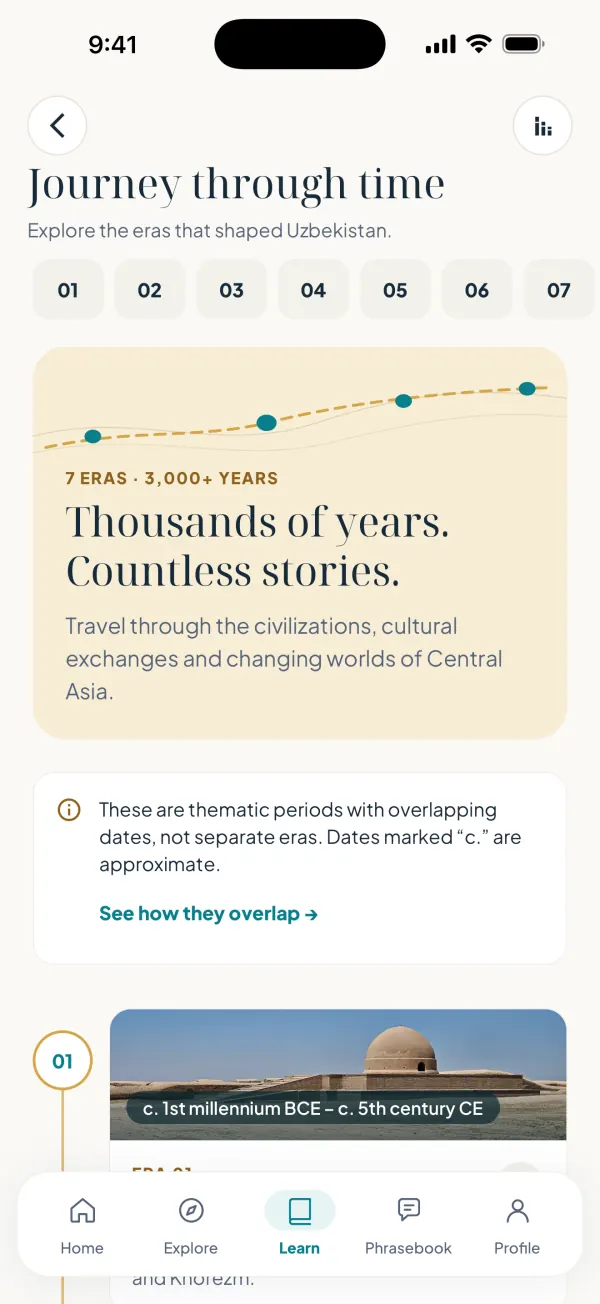
7 periods. They overlap in time: the Silk Roads, for example, span several of the others.

Photo: Richard Mortel / Wikimedia Commons, CC BY 2.0

c. 1st millennium BCE – c. 5th century CE

Ancient Civilizations

Oasis kingdoms of Sogdiana, Bactria and Khorezm.

Long before the Silk Roads had a name, farmers and townspeople lived in the valleys of the Zarafshan and the Amu Darya. Three ancient lands grew up here: Sogdiana around Samarkand, Bactria in the south and Khorezm on the lower Amu Darya. Their canals, walled towns and crafts laid the ground for everything that followed.

Key moments

  1. c. 1000 – 500 BCESogdiana is settled
  2. c. 7th century BCESamarkand begins on Afrosiyob
  3. 6th – 4th centuries BCEPart of the Persian world
  4. 329 BCEAlexander reaches Maracanda

Sources: Encyclopaedia Britannica: SogdianaUNESCO World Heritage Centre: Samarkand – Crossroad of CulturesEncyclopaedia Britannica: KhwarezmEncyclopaedia Britannica: Samarkand

Silk Road explorer

The Roads That
Connected Civilizations.

Discover the Silk Roads through cities, people, goods and ideas.

The Chinese envoy Zhang Qian travelled west to Central Asia. He is often credited with opening the first route from China to the West.

Source: UNESCO Silk Roads Programme: About the Silk Roads

SamarkandBukharaTermezChach (Tashkent)Fergana ValleyKhiva (Khwarazm)Merv
Schematic map: dashed lines show approximate connections between oasis cities, not traced roads; positions are approximate. Further along the routes: Chang’an (Xi’an).

Trade centre

Samarkand

Heart of Sogdiana and its merchants

The Sogdian language was first spoken in a region centred on Samarkand. Sogdian merchants carried it along the trade routes, where it became a shared language of traders as far as China.

Source: Smithsonian, National Museum of Asian Art: Sogdian Language and Its Scripts (Nicholas Sims-Williams)

Visit Samarkand today

There was no single Silk Road. The Silk Roads were a shifting web of routes, by land and by sea, that changed over the centuries. The name “Silk Road” is usually credited to the German geographer Ferdinand von Richthofen, who used “Seidenstraße” in 1877 and made the idea famous. Historians have since found the word in German writing from before 1877, so he helped spread the name rather than inventing it.

Great historical figures

Minds and Leaders
Who Left a Legacy.

No authentic portraits survive for most of these figures, so each is shown with a decorative monogram, not a likeness.

Mathematics & astronomy

Muhammad al-Khwarizmi

c. 780 – c. 850

Gave algebra its name, and “algorithm” comes from his.

Read profile

Muhammad ibn Musa al-Khwarizmi was a mathematician, astronomer and geographer of the early 9th century. His name points to Khwarazm, the oasis south of the Aral Sea, and he worked as a scholar at the House of Wisdom in Baghdad.

Sources: MacTutor History of Mathematics, University of St Andrews: Abu Ja’far Muhammad ibn Musa Al-KhwarizmiEncyclopaedia Britannica: al-Khwārizmī

Astronomy, geography & history

Abu Rayhan al-Biruni

973 – c. 1050

Polymath who measured the Earth and wrote a careful study of India.

Read profile

Abu Rayhan al-Biruni was born in Khwarazm in 973 and became one of the most wide-ranging scholars of his age. He wrote on astronomy, mathematics, geography, history, the calendar and the properties of metals.

Sources: MacTutor History of Mathematics, University of St Andrews: Abu Arrayhan Muhammad ibn Ahmad al-BiruniEncyclopaedia Britannica: Al-Bīrūnī

Astronomy & mathematics

Ulugh Beg

1394 – 1449

Astronomer-ruler of Samarkand who catalogued about a thousand stars.

Read profile

Ulugh Beg, Timur’s grandson, ruled Samarkand for about forty years and was himself a gifted astronomer and mathematician. His name is a title meaning “great prince”, and he turned the city into a centre of science.

Sources: MacTutor History of Mathematics, University of St Andrews: Ulugh BegComplete Dictionary of Scientific Biography (Scribner’s), via MacTutor: Ulugh Beg, by T. N. Kari-Niazov (Dictionary of Scientific Biography)

Astronomy & mathematics

Ali Qushji

1403 – 1474

Ulugh Beg’s astronomer, who carried Samarkand’s science to Istanbul.

Read profile

Ali Qushji grew up in Ulugh Beg’s Samarkand and studied with the scholars of his court. He became an astronomer at the Samarkand observatory and helped prepare Ulugh Beg’s great tables.

Sources: MacTutor History of Mathematics, University of St Andrews: Ala al-Din Ali ibn Muhammed Ali QushjiBiographical Encyclopedia of Astronomers (Springer), via MacTutor: Qushji (Biographical Encyclopedia of Astronomers)

Architectural heritage

Architecture That
Tells History.

Samarkand · Ancient Civilizations

Afrosiyob Museum

The hill of ancient Samarkand, with a museum of finds from its excavations.

Visit Afrosiyob Museum

Photo: Nassima Chahboun / Wikimedia Commons, CC BY-SA 4.0

Science & scholarship

A Heritage of Knowledge.

Scholars from this region worked within networks that stretched from Baghdad to Herat, wrote in Arabic, Persian and Turkic, and learned from Greek, Indian and Persian traditions. Their achievements belong to that shared world as much as to any single place.

  1. Beliefs & art · Ancient Civilizations

    Many traditions, one empire

    The Kushans helped spread Buddhism across Central Asia and into China. Their coins show Greek, Roman, Iranian, Hindu and Buddhist deities side by side, a sign of how many traditions met in the empire, and their wealth came largely from trade.

  2. Ideas & beliefs · The Silk Roads

    Faiths and knowledge on the move

    Ideas travelled with the caravans. Buddhism, Christianity, Islam, Hinduism, Zoroastrianism and Manichaeism all spread along the Silk Roads, and so did technologies such as papermaking and, later, printing.

  3. Science & knowledge · The Golden Age of Learning

    Measuring the world

    Al-Biruni introduced ways to measure the Earth and distances on it using triangulation. His Masudic Canon gives the coordinates of six hundred places, almost all of which he knew first-hand.

  4. Medicine & philosophy · The Golden Age of Learning

    Ibn Sina’s great books

    Ibn Sina served as physician to several rulers. His Canon of Medicine set out the achievements of Greek and Roman physicians in a clear system, and his Book of Healing covered logic, mathematics, astronomy, music and philosophy.

  5. Language & literature · The Golden Age of Learning

    The Samanid court

    The Samanid court in Bukhara welcomed scholars and poets. Under the Samanids, New Persian became a great language of literature and learning, and their potters developed a fine painted pottery.

  6. Science & knowledge · The Timurid Renaissance

    Mapping the sky

    Ulugh Beg’s Zij-i Sultani of 1437 gave the positions of about a thousand stars, the first comprehensive star catalogue since Ptolemy’s. He measured the length of the year as 365 days, 5 hours, 49 minutes and 15 seconds.

  7. Art & literature · The Timurid Renaissance

    The painters of Herat

    Kamoliddin Behzod, raised in Herat, headed the city’s painting academy from 1486 to 1506 and is counted among the great Persian miniaturists. He signed few works, and only 32 paintings are firmly attributed to him.

Sources: Encyclopaedia Britannica: Kushan dynastyUNESCO Silk Roads Programme: About the Silk RoadsMacTutor, University of St Andrews: Abu Arrayhan Muhammad ibn Ahmad al-BiruniEncyclopaedia Britannica: AvicennaEncyclopaedia Britannica: Samanid dynastyMacTutor, University of St Andrews: Ulugh BegEncyclopaedia Britannica: Behzād

Historical stories

Stories Worth Remembering.

7 short illustrated stories, each a few minutes long, with the full chapters in the app.

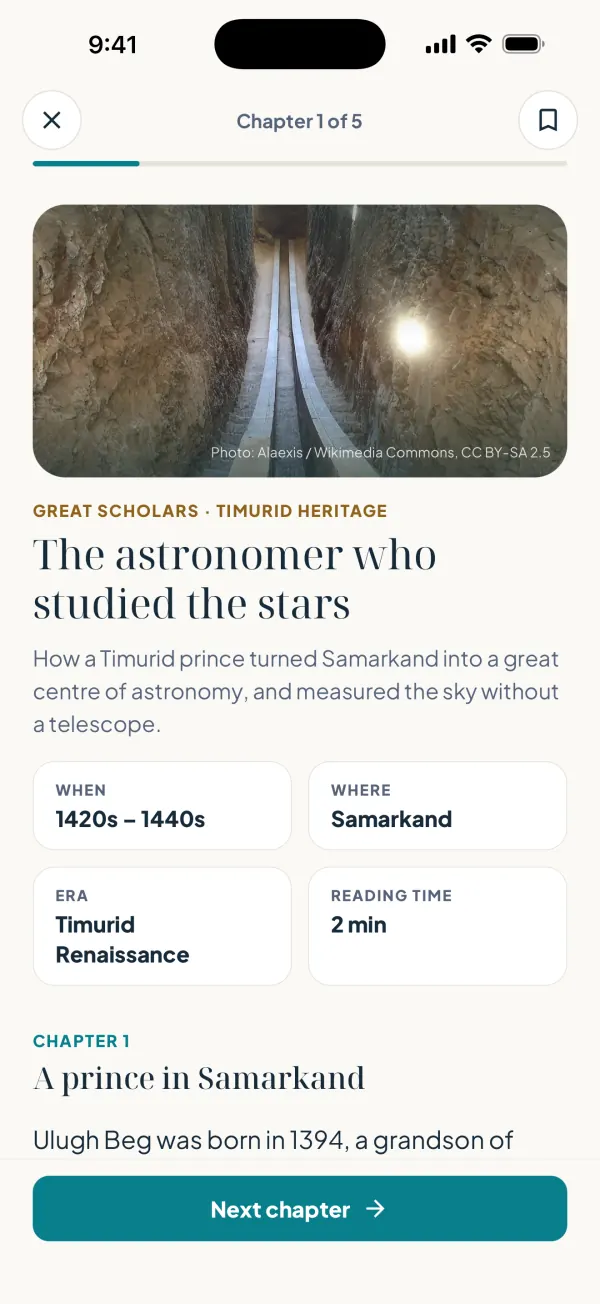
Photo: Alaexis / Wikimedia Commons, CC BY-SA 2.5

Great scholars · Timurid heritage

The astronomer who studied the stars

How a Timurid prince turned Samarkand into a great centre of astronomy, and measured the sky without a telescope.

Photo: Bgag / Wikimedia Commons

Architecture · Timurid heritage

The story of the Registan

Three madrasas, built two centuries apart, facing one another across Samarkand’s great square.

Photo: Bodleian Libraries, University of Oxford / Wikimedia Commons

Great scholars · Islamic Golden Age

Al-Khwarizmi and the language of mathematics

The scholar whose name gave us the word “algorithm”, and whose book gave us “algebra”.

Photo: Fulvio Spada from Torino, Italy / Wikimedia Commons, CC BY-SA 2.0

Great scholars · Islamic Golden Age

Ibn Sina and the Canon of Medicine

A gifted young scholar from near Bukhara wrote a medical encyclopaedia that was studied for centuries.

Photo: LBM1948 / Wikimedia Commons, CC BY-SA 4.0

Silk Roads · Crafts

Paper in Samarkand

How Samarkand became famous for its paper, the legend of 751, and the water wheel that turns again today.

Photo: Iaa2023 / Wikimedia Commons, CC BY-SA 4.0

Ancient civilizations · Cultural exchange

Where Buddhism crossed the river

Monasteries near the Amu Darya, where monks, merchants and ideas from India met the lands to the north.

Photo: Patrickringgenberg / Wikimedia Commons, CC BY-SA 3.0

Architecture · Islamic Golden Age

Bukhara’s brick masterpiece

A small cube of baked brick, more than a thousand years old, whose patterns seem to change with the light.

Interactive discovery

History Is Better
When You Explore It.

Five short questions per topic, drawn from the sourced history on this page. Nothing is saved or sent.

Question 1 of 5

Score 0

What did the ancient Greeks call Samarkand?

History meets travel

Walk Where
History Happened.

  • Heart of Sogdiana and its merchants

    Samarkand

    Where the Silk Roads come alive.

    Photo: Գարվիք / Wikimedia Commons, CC BY-SA 4.0

  • Oasis of caravans and learning

    Bukhara

    A living museum of the Silk Road.

    Photo: Adam Jones from Kelowna, BC, Canada / Wikimedia Commons, CC BY-SA 2.0

  • Last stop before the desert

    Khiva

    A fairy-tale city inside mud-brick walls.

    Photo: Adam Harangozó / Wikimedia Commons, CC BY-SA 4.0

  • North-eastern edge of Sogdiana

    Tashkent

    The modern face of an ancient crossroads.

    Photo: Bgag / Wikimedia Commons

From the blog

Read More About
Uzbekistan’s Past.

Registan Samarkand: A Deep Dive. Uzbekistan travel.

History & Heritage

Registan Samarkand: A Deep Dive

Registan Samarkand guide: the three madrasas, the famous tiger mosaics, best visiting times, the evening light show, and the astronomer-king's story.

7 min read

Rusting fishing boats stranded on cracked seabed near Moynaq, with yurts and a tiled facade under a warm desert sky.

Destinations

Karakalpakstan: The Aral Sea, Moynaq & Nukus

A traveler's guide to Karakalpakstan: the Moynaq ship graveyard, the shrinking Aral Sea, the Savitsky museum in Nukus, and yurt-camp logistics.

6 min read

Get the app

Carry Uzbekistan’s History with You.

Read illustrated stories, follow the timeline era by era, explore the Silk Roads and test yourself with history quizzes, wherever your journey takes you.

Android Google Play · coming soon

Scan with your iPhone camera to open the App Store.

Salom Uzbekistan app: the history timeline
Salom Uzbekistan app: an illustrated history story