Registan Samarkand: A Deep Dive
Registan Samarkand guide: the three madrasas, the famous tiger mosaics, best visiting times, the evening light show, and the astronomer-king's story.
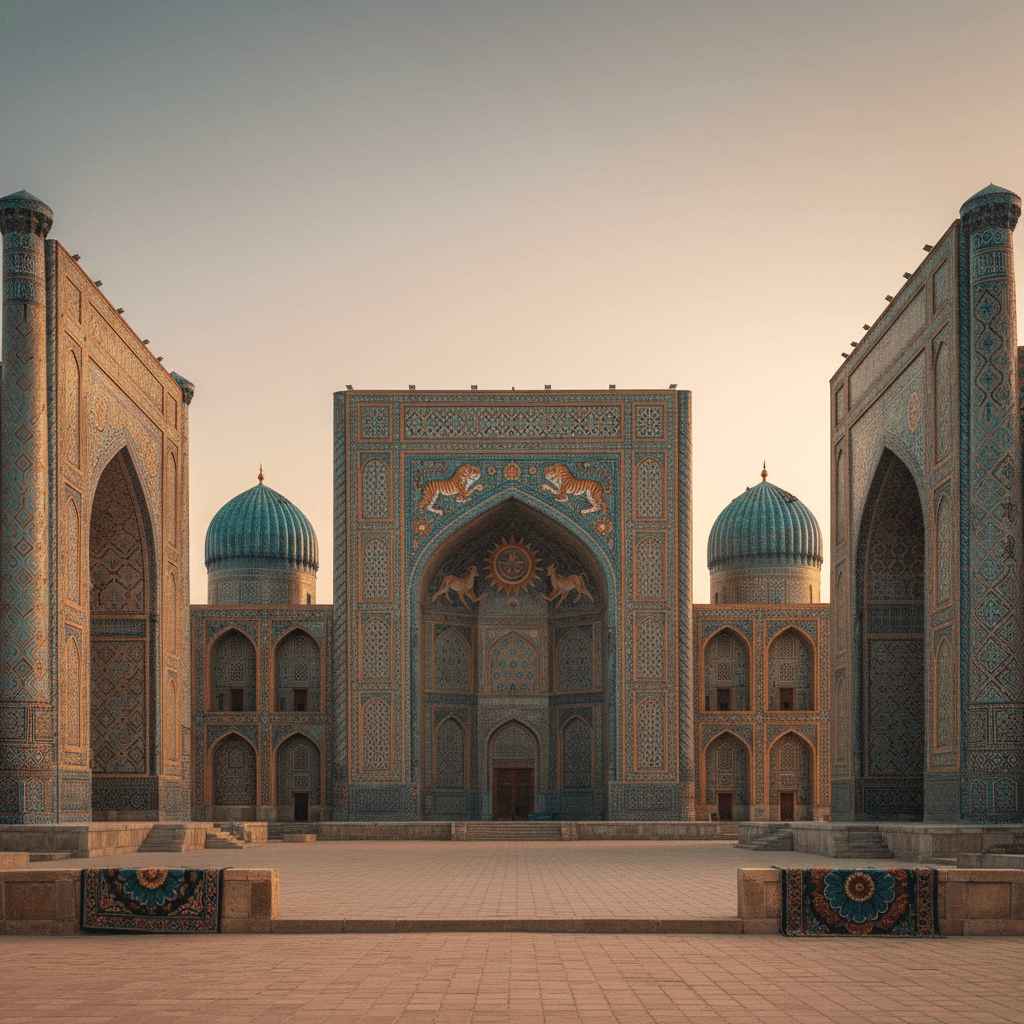
Stand in the middle of the Registan in Samarkand and you’re hemmed in on three sides by towering portals, each one a wall of blue and gold tile. It’s the kind of place that makes people go quiet for a second before they reach for a camera.
This is the postcard image of Uzbekistan for good reason. Here’s what the Registan Samarkand square actually is, when to come, and the backstory that makes one of these buildings stranger than the others.
What is the Registan square?
The word Registon reh-gee-STAHN means “sandy place,” which is a plain name for a grand square. In Timurid times this was the commercial and civic heart of the city: a market, a gathering point, a place where royal proclamations were read out to crowds.
Three madrasas (Islamic schools) frame the square today. They were built across roughly two centuries, so they aren’t a single matched set. They’re closer to three statements made by three rulers who each wanted to outdo the last.
You can walk the open plaza for free, but going inside the courtyards and climbing the surviving structures needs a ticket. Buy it at the booth near the entrance.
The three madrasas
Face the square from the open end and you’ll see all three at once: one straight ahead, one on your left, one on your right.
Ulugh Beg Madrasa (the oldest)
The one on your left is the Ulugh Beg Madrasa, finished in the 1420s. It’s the senior building, and it set the template for the other two.
Ulugh Beg was Timur’s grandson, and he cared more about mathematics and the stars than about conquest. He taught here himself. The decoration leans on geometry and starry motifs, which fits a man who spent his nights mapping the sky. More on him below, because his story doesn’t end well.
Sher-Dor Madrasa (the tigers)
Directly across the square is the Sher-Dor Madrasa, built about two hundred years later in the 1630s. The name means “having tigers,” and that’s the thing everyone photographs.
Look up at the main portal. Two big striped cats (usually called tigers, sometimes lions) chase deer across the front, with a human-faced sun rising behind each one. Depicting living creatures on a religious building was unusual in Islamic art, so the mosaic has always drawn comment. Whether it was a bold artistic choice or a ruler flexing his authority, nobody can say for certain. It’s the single most famous detail at the Registan.
Tilya-Kori Madrasa (the gold one)
The building straight ahead is the Tilya-Kori Madrasa, from the mid-1600s. The name means “gilded,” and you’ll understand why the moment you step into its mosque on the left side of the courtyard.
The interior is covered in gold leaf laid over a deep blue ground, and the ceiling is painted flat but tricks your eye into reading it as a dome. Stand under it and look straight up. This building doubled as the city’s main Friday mosque after Bibi-Khanym fell into ruin, so it had to impress as well as teach.
The tilework, up close
The Registan is a lesson in two tile techniques side by side.
- Mosaic faience: tiny cut pieces of glazed ceramic fitted together like a jigsaw. Slow, expensive, sharp-edged. You see it on the finest panels.
- Cuerda seca (“dry cord”): tiles painted with several colors at once, separated by a greasy line that keeps the glazes from running together during firing. Faster, slightly softer-looking up close.
The dominant blues come from cobalt and turquoise glazes. Run your eye along the calligraphy bands and you’ll spot verses worked into the geometry, where the writing itself becomes pattern. If you like this kind of detail, the tile at Shah-i-Zinda across town is even more intimate, since you can get close enough to touch it.
The astronomer-king behind it
Ulugh Beg is the most interesting figure here. He built an observatory on a hill north of the square with a huge curved instrument set into the ground, and his team measured the positions of more than a thousand stars with an accuracy that held up for centuries. His star tables were studied in Europe long after his death.
He was a far better scientist than politician. After Timur’s empire began to fracture, Ulugh Beg lost power, and in 1449 he was killed on the orders of his own son. His observatory was torn down soon after. The madrasa on the square is the building that still carries his name, which is a fitting memorial for a man who taught in it.
If you want the wider picture of Timurid Samarkand, the Gur-e-Amir Mausoleum holds Timur’s tomb (and Ulugh Beg’s), and it’s a short ride away.
Best time to visit the Registan
The square faces roughly so that morning light hits the Tilya-Kori portal and the late afternoon sun warms the Sher-Dor tigers. Both are good. Midday is the harsh option, flat and crowded.
A few honest tips:
- Come at opening if you want the courtyards without tour groups. The first hour is the calmest.
- Late afternoon gives you golden light on the tilework and a softer crowd as the day groups leave.
- Bring a light jacket for spring and autumn evenings. Samarkand gets cool after sunset even when the days are warm.
- Dress modestly if you plan to enter the mosque interior. Shoulders and knees covered is the safe rule. See our notes on mosque etiquette.
For the wider season question, our month-by-month guide covers when Samarkand is most comfortable.
The evening light show
After dark, the Registan runs a sound-and-light show projected onto the three facades, usually in the warmer months. The buildings light up in shifting color while a narration tells the city’s history.
It’s a little theatrical, and the narration may not always be in English, but watching those portals glow against a black sky is worth staying out for. Check the current schedule locally, since timing shifts with the season and isn’t always posted online. A polite Qachon boshlanadi? kah-CHON bosh-lah-NAH-dee (when does it start?) at your hotel desk usually sorts it out.
How it fits your Samarkand day
The Registan deserves an hour or two on its own, more if you climb a minaret or linger in the courtyards. Most people pair it with Shah-i-Zinda and Bibi-Khanym in a single packed day.
For a full route that links them sensibly, see our things to do in Samarkand plan. You can also read more about the Registan Square on its own place page.
Frequently asked questions
How much does it cost to enter the Registan?
Walking the open square is free. Entering the madrasa courtyards and interiors needs a paid ticket from the booth at the entrance; prices change, so check on the day rather than trusting old figures online.
Why does the Sher-Dor Madrasa have tigers on it?
The Sher-Dor portal shows two striped cats chasing deer beneath a human-faced sun. Living creatures are unusual in Islamic religious decoration, and the exact reason is debated. It may have been an artistic flourish or a display of royal power.
How long should I spend at the Registan?
Plan on one to two hours to see all three madrasas properly. Add more if you want to climb a minaret or return in the evening for the light show.
Who was Ulugh Beg?
Ulugh Beg was Timur’s grandson, a ruler and astronomer who built an observatory in Samarkand and produced famous star tables. He taught at the madrasa that bears his name and was killed by his son’s order in 1449.
Is the Registan worth visiting at night?
Yes, if the season’s light show is running. The lit facades against a dark sky are striking, even if the narration is theatrical. Confirm the schedule locally before you go.
Want to ask a guard about the light-show time or thank the ticket seller without fumbling? Salom Uzbekistan keeps offline Uzbek phrases and audio in your pocket, so you can say Rahmat rah-MAHT (thank you) and a few useful lines even with no signal in the square.