Learn
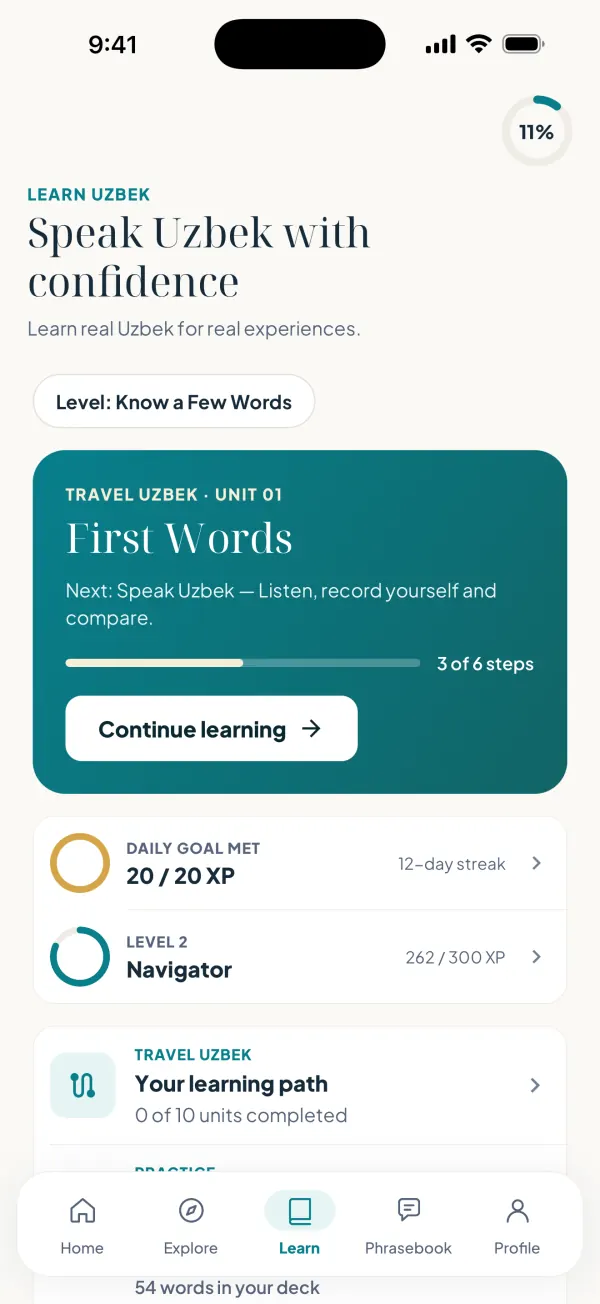
Short lessons introduce a handful of words for a real travel situation.
Learn Uzbek
Learn the language. Connect with the culture.
Discover practical Uzbek through interactive lessons, useful travel phrases, pronunciation practice and real-life conversations.
Free on this page, no account needed: flashcards, a mini quiz, a conversation and a phrasebook preview. Full lessons are in the app.
Try it now
Tap the card, or press Space, to reveal the meaning. Use the arrow keys or the buttons to move between words.
New here? Start with “Assalomu alaykum”: say it out loud, then flip the card.
A few words play audio right here. In the app, every phrase has clear Uzbek audio in a female and a male voice.
First words
1 / 8

Why learn Uzbek?
Many people in Uzbekistan also speak Russian, but Uzbek is the language of daily life. A few words show respect and open doors.
Greet people respectfully
“Assalomu alaykum” with a hand on the heart is noticed and warmly returned.
Communicate at markets
“Bu qancha?” (how much is this?) and a few numbers make the bazaar friendlier.
Order food
Ask for tea, bread and the bill, and tell your host the food is “mazali” (delicious).
Ask for directions
“… qayerda?” (where is …?) and left, right and straight ahead get you a long way.
Understand local culture
Words like “mehmon” (guest) and “dasturxon” (the laid table) open up how people live.
Build real connections
Even a few words turn a transaction into a conversation.
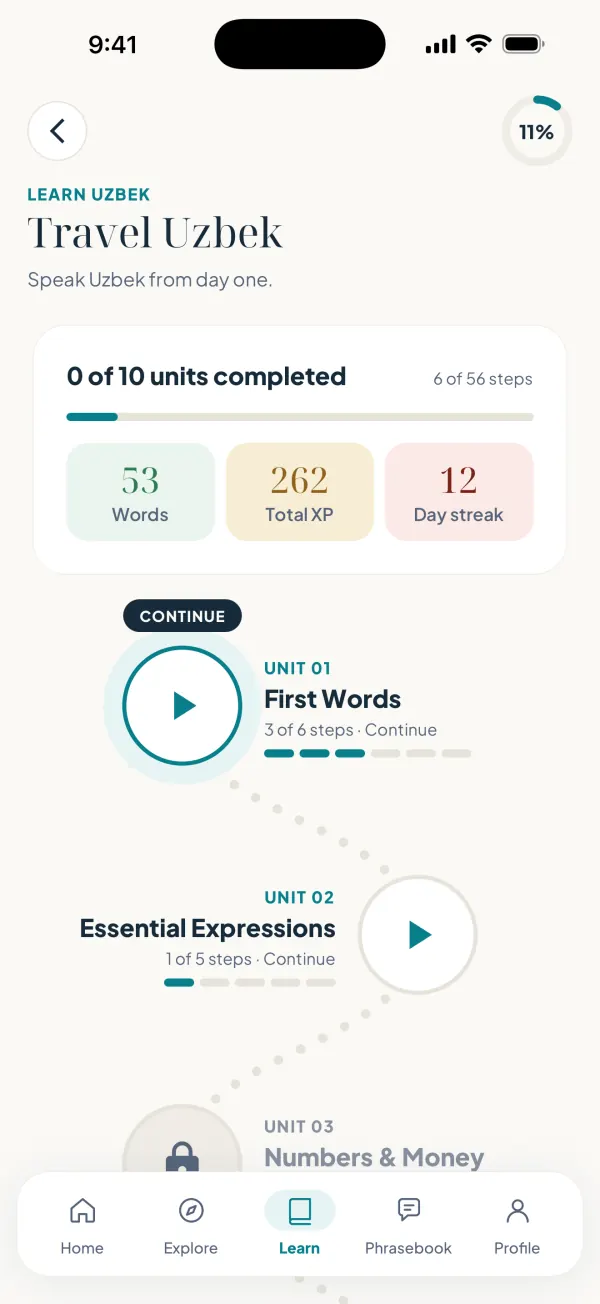
Travel Uzbek curriculum
12 practical units, from your first words to emergencies.
Start speaking Uzbek with essential greetings and everyday courtesies.
Ask where, when and how much — and ask for help when you need it.
Count from one to a thousand and understand prices at the till.
Find your way on arrival and answer simple questions at passport control.
Hail a taxi, give your destination and agree the fare before you go.
Check in, find out about breakfast and Wi-Fi, and sort out the bill.
Name the classics, order a portion and ask for the bill like a local.
Ask prices, bargain politely and pick the ripest fruit at the bazaar.
Ask where things are and follow the answer — near, far, left or right.
Accept tea the Uzbek way and know what a half-full bowl really means.
Go beyond phrases: everyday verbs and the word order behind Uzbek sentences.
Ask for help, explain a problem and find a doctor or the police.
The Salom Uzbekistan app teaches every unit step by step: learn, listen, match and speak, with a practice conversation in many units and a short unit check at the end.
How you’ll learn
Short lessons introduce a handful of words for a real travel situation.
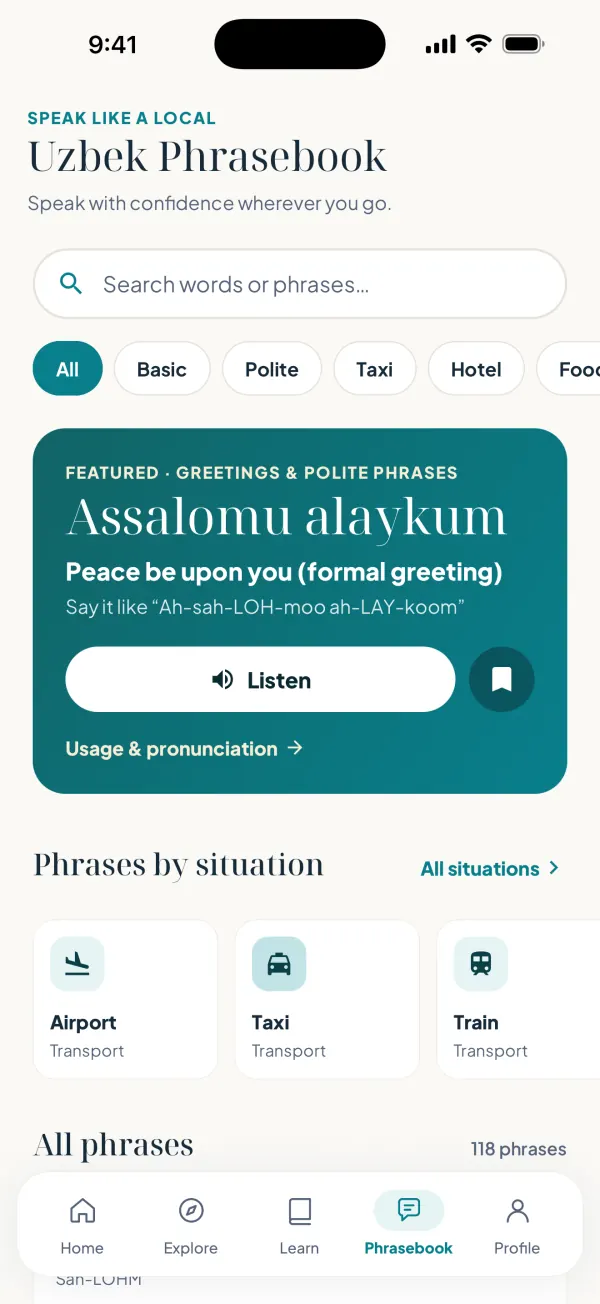
Every phrase has clear Uzbek audio, in a female and a male voice.
Record yourself and compare with the model. Recordings stay on your phone, and nothing is scored.
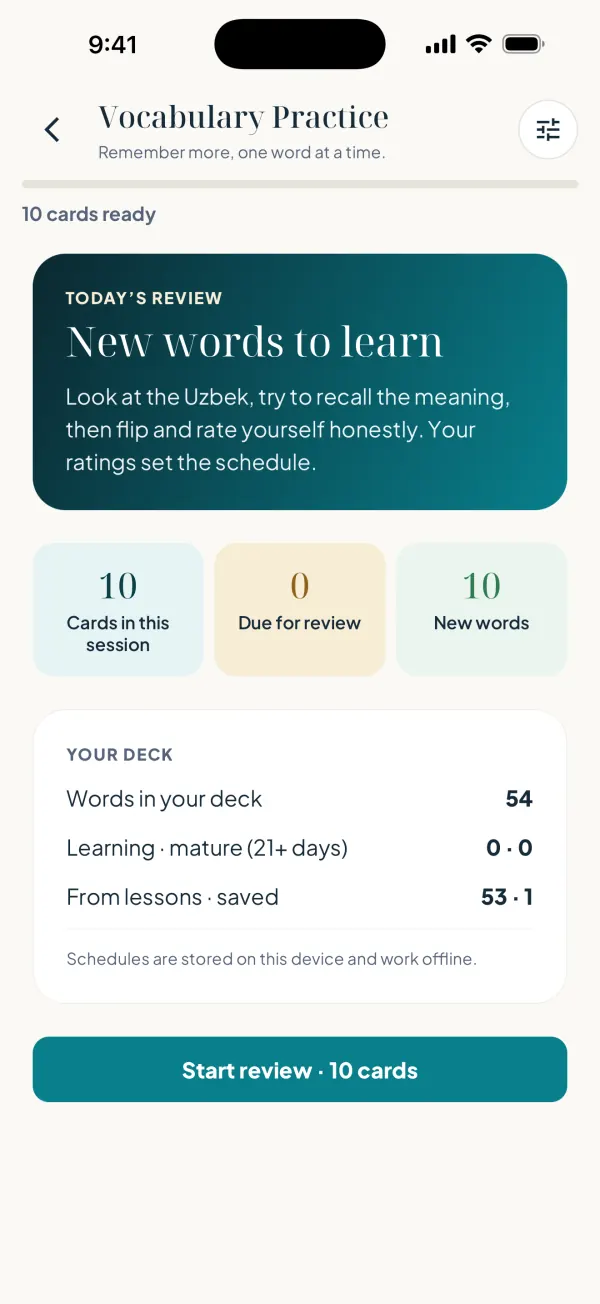
Spaced-review flashcards bring back the words you find hardest, right when they’re due.
Mini lesson · No account needed
5 quick questions on your first words. Nothing is saved or sent.
Question 1 of 5
Score 0
What does “Assalomu alaykum” mean?
Real-life conversation
Read along, then choose what you would say. Turn translations off to test yourself.
AT A FRUIT STALL · BAZAAR
Pronunciation practice
Read the guide, record yourself and listen back. Compare it with the guide and try again.
Recordings stay in this browser tab and are discarded when you leave. Nothing is uploaded and nothing is scored.
Practice phrase
Assalomu alaykum
Ah-sah-LOH-moo ah-LAY-koom
Peace be upon you (formal greeting)
Press Record. Your browser will ask for microphone permission.
Language & culture

Greetings & Respect
Assalomu alaykum
“Peace be upon you”
Proper handshakes, the 'hand-to-heart' gesture, and formal addresses.
Read the guide to Greetings & Respect
The Art of Uzbek Hospitality
Mehmondorchilik uchun rahmat
“Thank you for the hospitality”
Understanding the 'Mehmondorchilik' tradition and the guest's sacred role.
Read the guide to The Art of Uzbek Hospitality
Bazaar Etiquette
Bu qancha turadi?
“How much does this cost?”
The art of respectful bargaining and navigating traditional markets.
Read the guide to Bazaar Etiquette
Tea Culture
Choy ichsak
“Shall we have some tea?”
The ritual of tea pouring and why a half-full cup is a sign of respect.
Read the guide to Tea Culture
Mosque Etiquette
Ruxsat berasizmi?
“May I? (asking permission)”
Dress codes and behavior when visiting active religious sites.
Read the guide to Mosque EtiquettePhrasebook preview
123 phrases with pronunciation, by situation. The full phrasebook, with audio and offline access, is in the app.
8 phrases
Assalomu alaykum
Peace be upon you (formal greeting)
Ah-sah-LOH-moo ah-LAY-koom
Salom
Hello (informal)
Sah-LOHM
Xush kelibsiz
Welcome
Khoosh keh-LEEB-seez
Rahmat
Thank you
Rah-MAHT
Ha / Yo'q
Yes / No
Hah / Yohk
Kechirasiz
Excuse me / Sorry
Keh-chee-RAH-seez
Xayr
Goodbye
Khah-eer
Yaxshimisiz?
How are you? (formal)
Yakh-shee-MEE-seez
Bir
One (1)
Beer
Ikki
Two (2)
Eek-KEE
Uch
Three (3)
Ooch
To'rt
Four (4)
Tohrt
Besh
Five (5)
Behsh
Olti
Six (6)
Ohl-TEE
Yetti
Seven (7)
Yeht-TEE
Sakkiz
Eight (8)
Sahk-KEEZ
Qayerda?
Where?
Kah-YEHR-dah
Qachon?
When?
Kah-CHOHN
Qanday?
How? / What kind?
Kahn-DAI
Nima?
What?
Nee-MAH
Kim?
Who?
Keem
Nega?
Why?
Neh-GAH
Qancha?
How much? / How many?
Kahn-CHAH
Bu nima?
What is this?
Boo nee-MAH
Taksi
Taxi
Tahk-SEE
Menga taksi kerak
I need a taxi
Mehn-GAH tahk-SEE keh-RAHK
...ga olib boring
Take me to...
...gah oh-LEEB boh-REENG
To'xtang
Stop
Tohkh-TAHNG
Qancha bo'ladi?
How much will it be?
Kahn-CHAH boh-LAH-dee
Tezroq
Faster
Tehz-ROHK
Sekinroq
Slower
Seh-keen-ROHK
Shu yerda to'xtating
Stop here, please
Shoo yehr-DAH tohkh-TAH-teeng
Chap
Left
Chahp
O'ng
Right
Ohng
To'g'ri
Straight
Toh-gree
Orqaga
Back / backwards
Or-kah-gah
Yaqin
Near / close
Yah-keen
Uzoq
Far
Oo-zok
Qayerda?
Where?
Kah-yehr-dah?
...qayerda joylashgan?
Where is ... located?
...kah-yehr-dah joy-lahsh-gahn?
Mehmonxona
Hotel / guesthouse
Meh-mon-kho-nah
Xona
Room
Kho-nah
Kalit
Key
Kah-leet
Bron qilish
To book / reservation
Bron kee-leesh
Wi-Fi paroli nima?
What is the Wi-Fi password?
Wai-Fai pah-roh-lee nee-mah?
Chiqish vaqti qachon?
When is check-out time?
Chee-keesh vahk-tee kah-chon?
Nonushta
Breakfast
Noh-noosh-tah
Issiq suv bormi?
Is there hot water?
Ees-seek soov bor-mee?
Palov
Pilaf (rice dish)
Pah-LOHV
Non
Bread
Nohn
Choy
Tea
Choy
Somsa
Baked pastry with meat filling
Sohm-sah
Shashlik
Grilled meat skewers
Shahsh-leek
Lag'mon
Hand-pulled noodles
Lahgh-mon
Menyu bering
Give me the menu
Meh-nyoo beh-ring
Hisob, iltimos
The bill, please
Hee-sob, eel-tee-mohs
Bozor
Bazaar / market
Boh-zor
Bu qancha?
How much is this?
Boo kahn-chah?
Arzonroq qiling
Make it cheaper
Ar-zon-rok kee-ling
Chegirma bormi?
Is there a discount?
Cheh-geer-mah bor-mee?
Kilogramm
Kilogram
Kee-lo-grahm
Shirin
Sweet
Shee-reen
Yangi
Fresh / new
Yahn-gee
Pishiq
Ripe
Pee-sheek
Choy
Tea
Choy
Ko'k choy
Green tea
Kohk choy
Qora choy
Black tea
Koh-RAH choy
Piyola
Traditional tea bowl
Pee-yoh-LAH
Dasturxon
Tablecloth / Spread for meals
Dahs-toor-KHOHN
Marhamat, o'tiring
Please, sit down
Mar-hah-MAHT, oh-TEE-ring
Choy ichasizmi?
Will you have tea?
Choy ee-chah-SEEZ-mee
Mehmon
Guest
Meh-MOHN
Bormoq
To go
Bohr-MOHK
Kelmoq
To come
Kel-MOHK
Yemoq
To eat
Yeh-MOHK
Ichmoq
To drink
Eech-MOHK
Ko'rmoq
To see
Kohr-MOHK
Bilmoq
To know
Beel-MOHK
Gapirmoq
To speak
Gah-peer-MOHK
Olmoq
To take / To get
Ohl-MOHK
Men kitob o'qiyman
I read a book (Subject-Object-Verb)
Men kee-TOHB oh-KEEY-mahn
Men Toshkentda yashayman
I live in Tashkent
Men Tohsh-KENT-dah yah-SHAH-ee-mahn
Bu kitobmi?
Is this a book?
Boo kee-TOHB-mee
Siz talabamisiz?
Are you a student?
Seez tah-lah-BAH-mee-seez
Men talaba emasman
I am not a student
Men tah-lah-BAH eh-MAHS-mahn
Men bormayman
I don't go / I won't go
Men bohr-MAI-mahn
Mening ismim Anvar
My name is Anvar
Meh-NING ees-MEEM Ahn-VAHR
Chiroyli shahar
Beautiful city
Chee-ROY-lee shah-HAHR
No phrases match that search. Try another word.
Copy puts the Uzbek text on your clipboard, ready to show someone or paste into a message.
In the app
The app tracks your learning path, completed lessons, the words you know, badges and a daily goal you choose.
Progress is stored on your phone.
Questions
From the blog

Learn Uzbek
Learn 20 essential uzbek phrases for greetings, taxis, bazaars and restaurants, plus how to read the Latin script and the tricky o' and g' sounds.

Culture & Traditions
Religion in Uzbekistan is mostly secular Sunni Islam with Sufi roots. Here's what it means for mosque etiquette, dress, Ramadan, and the great monuments.

Culture & Traditions
Uzbek tea is the heart of every social moment. Learn the choyxona, the three-pour ritual, green vs black, the piyola, and how to accept a cup politely.
Get the app
Practise useful phrases, complete interactive lessons and build confidence with Salom Uzbekistan. Free to download, with a free trial of everything.

Android Google Play · coming soon
Scan with your iPhone camera to open the App Store.