Things to Do in Bukhara: The Walkable Old Town
The best things to do in Bukhara: the Poi-Kalyan ensemble, the Ark fortress, Lyab-i-Hauz, the trading domes, and Chor Minor, all on foot.
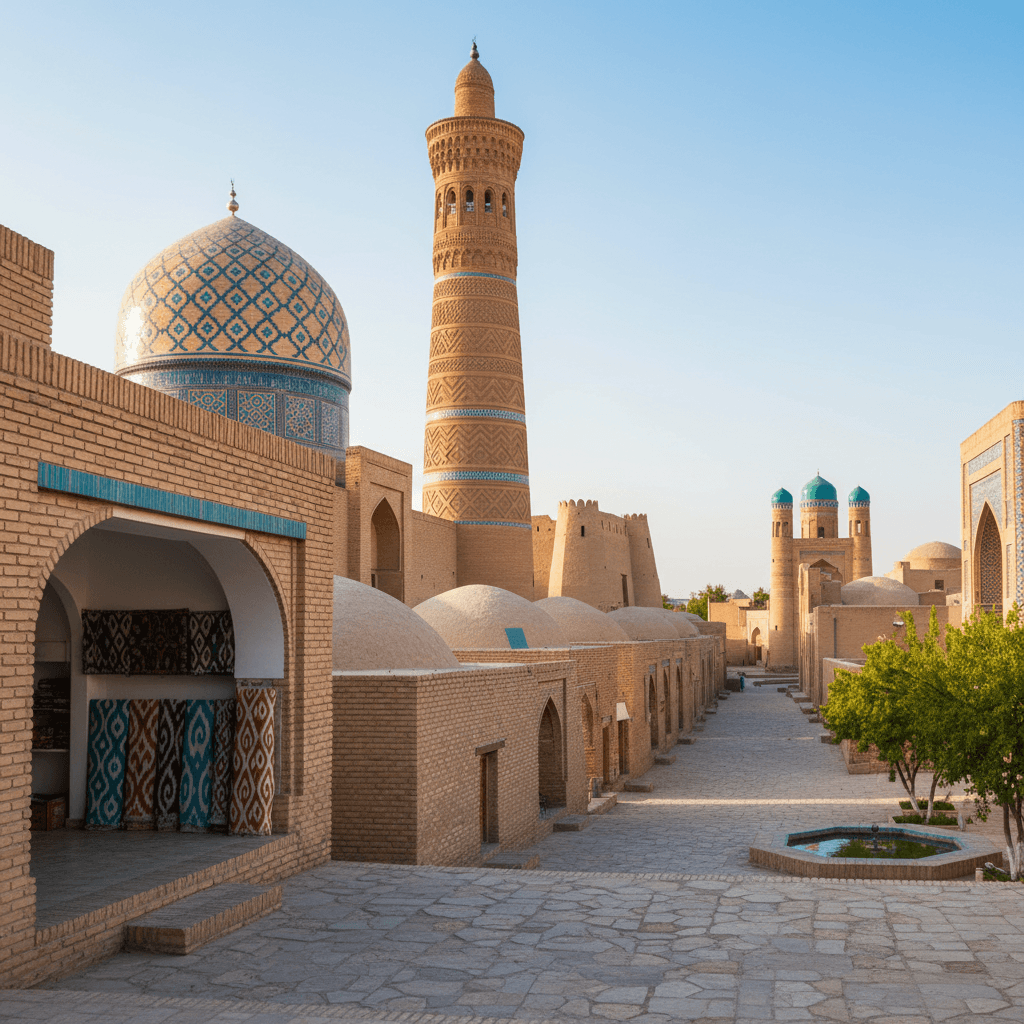
Some cities make you choose between sights and atmosphere. Bukhara doesn’t. The whole old town is an open-air museum you can sleep inside, since many of the guesthouses sit in restored 19th-century merchant homes a two-minute walk from a 12th-century minaret.
The best things to do in Bukhara almost all happen on foot, within one compact, sandy-walled core. Here’s how to spend your time, what to see, and how not to get lost in the lanes (you will get a little lost, and that’s fine).
Start with the Poi-Kalyan ensemble
If you only have an hour, give it to the Po-i-Kalyan complex. The Kalyan Minaret has stood since 1127, and the story goes that Genghis Khan was so impressed he ordered it spared when his army flattened almost everything else.
Stand in the square between the minaret, the Kalyan Mosque, and the Mir-i-Arab Madrasa around late afternoon. The brick turns gold, the crowds thin, and the scale finally lands.
The mosque courtyard is enormous and usually quiet. Cover your shoulders and knees, and women may want a scarf for the prayer areas. A quick read of mosque etiquette before you go saves you the awkward shuffle at the door.
Climb the Ark of Bukhara
A few minutes west, the Ark of Bukhara is the oldest thing in town: a massive mud-brick fortress that was home to Bukhara’s emirs for over a thousand years. Most of what stands today dates to the 18th century, but people have lived on this mound since antiquity.
Inside you’ll find a few small museums, the old throne court, and the reconstructed coronation hall. The views over the rooftops from the ramparts are worth the ticket on their own.
Go in the morning if you can. The Ark faces east, so the light is kinder early, and you’ll beat the tour groups that arrive mid-morning.
Slow down at Lyab-i-Hauz
When your feet complain, head to Lyab-i-Hauz, the shaded pool at the heart of the old town. Mulberry trees that are several centuries old lean over the water, and the surrounding teahouses have been doing the same thing for generations: pouring tea and feeding people slowly.
Sit. Order a pot of green tea and some bread. Bir choynak ko'k choy beer choy-NAHK kook choy means “one pot of green tea,” which is most of what you need here.
This is the best people-watching spot in Bukhara. Locals come for the evening too, so it stays lively after dark when the buildings get lit up.
Wander the trading domes
Between Lyab-i-Hauz and Poi-Kalyan, the lanes pass under three domed bazaars built in the 16th century. Each one had a specialty: Toqi Zargaron for jewelers, Toqi Telpak Furushon for hatmakers and the famous fur caps, Toqi Sarrafon for moneychangers.
Today they sell carpets, miniatures, knives, scarves, and a lot of ceramics. Quality swings wildly, so take your time and compare. Bukhara suzani embroidery and the dark-blue ceramics are genuinely good buys if you find a careful seller.
Bargaining is expected but gentle here. A relaxed back-and-forth gets you a better price and a friendlier exchange than a hard push. If you’re unsure how it works, our guide to bazaar etiquette covers the rhythm of it. A warm Qancha turadi? kahn-CHA too-RAH-dee (how much is it?) opens almost any conversation.
Find Chor Minor
A short walk east of the main core, tucked into a residential lane, Chor Minor is the building you’ve probably seen on a postcard without knowing where it was. Its four small blue-capped towers (the name means “four minarets”) once formed the gatehouse of a vanished madrasa.
It’s small. You’ll spend ten minutes here, maybe climb to the roof, and then walk back. But the detour through the quiet neighborhood lanes is half the point, and you’ll see ordinary Bukhara life that the main square hides.
How to plan your days
Most of these Bukhara attractions sit within a 15-minute walk of each other. One full day covers the highlights; two days lets you slow down and revisit the trading domes or the teahouses without rushing.
A loose plan that works:
- Morning: the Ark, then the nearby Bolo Hauz Mosque with its wooden columns.
- Midday: lunch and tea near Lyab-i-Hauz.
- Afternoon: the trading domes, then Poi-Kalyan for the golden hour.
- Evening: dinner in the old town, and a slow walk back past the lit-up minaret.
If you’re stitching Bukhara into a longer trip, our 7 and 10-day Uzbekistan itinerary shows how the fast train links it to Samarkand and Khiva.
What to eat while you’re here
Bukhara’s food leans hearty. You’ll see shashlik shash-LIK grilling on every corner and rounds of non bread stamped with patterns and stacked at the bazaars. The local plov is sweeter and often topped with chickpeas and raisins, a little different from the Tashkent or Samarkand versions.
For a sit-down meal, the restaurants around Lyab-i-Hauz are easy but touristy. Walk a few lanes out and prices drop while portions grow.
A polite Rahmat rah-MAHT (thank you) to your server goes a long way, and Mazali mah-zah-LEE (delicious) usually earns a real smile.
Frequently asked questions
How many days do you need in Bukhara?
One full day covers the main sights since they’re all walkable. Two days is the sweet spot if you want to slow down, shop the trading domes properly, and enjoy the evenings without rushing.
What is the must-see in Bukhara old town?
The Poi-Kalyan ensemble, with its 12th-century minaret, is the centerpiece. Pair it with the Ark fortress and a long pause at Lyab-i-Hauz, and you’ve seen the soul of the old town.
Is Bukhara walkable?
Very. The historic core is compact, mostly car-free in the center, and you can reach almost every major site on foot. Wear comfortable shoes, because the lanes are cobbled and uneven in places.
What should I buy in Bukhara?
Suzani embroidery, hand-painted ceramics, miniature paintings, and the traditional fur hats sold in the trading domes. Compare a few stalls and bargain gently before you commit.
Is Bukhara worth visiting compared to Samarkand?
Yes, and for different reasons. Samarkand has the grander single monuments, while Bukhara gives you a whole lived-in old town to wander. Many travelers find Bukhara the more atmospheric of the two.
Want the phrases above ready when you’re standing in a teahouse with no signal? The Salom Uzbekistan app has offline audio for greetings, bargaining, and ordering. Download it here before you go and practice on the train in.